Judge says Missouri House lacked authority to dock Wiley Price’s pay after 2021 censure

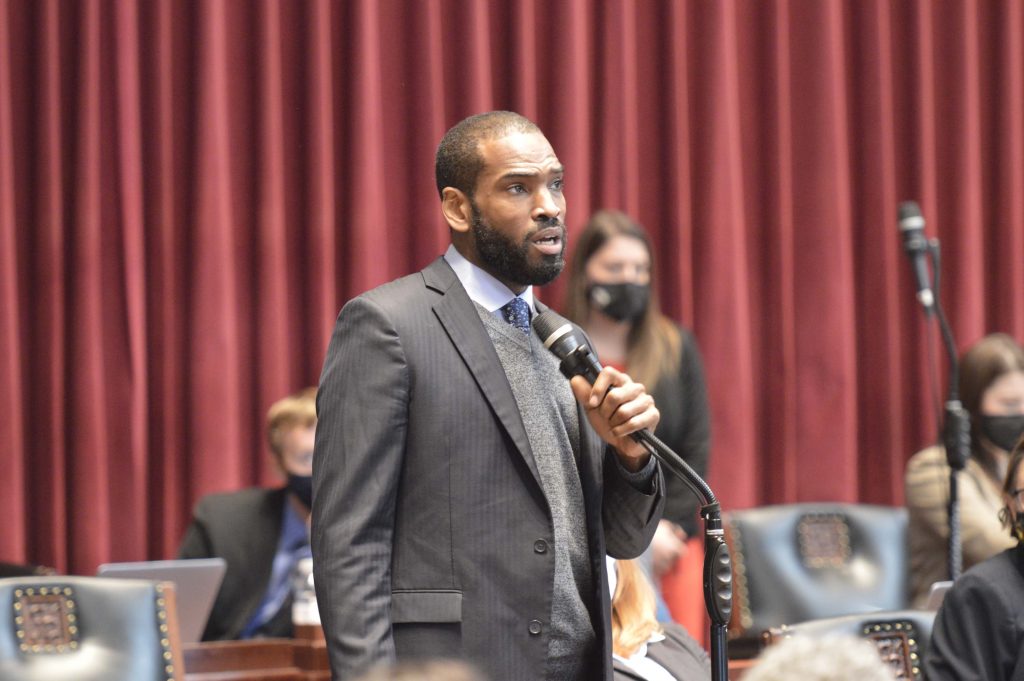
Former state Rep. Wiley Price discusses the effort to censure him during House debate on Jan. 13, 2021 (Ben Peters/Missouri House Communications).
A Cole County judge has ordered Missouri officials to repay former state Rep. Wiley Price more than $22,000, ruling the House lacked lawful authority to enforce a financial penalty imposed as part of his 2021 censure.
In a judgment last week, Circuit Judge Brian Stumpe found Price was entitled to recover the full $22,492.25 withheld from his legislative pay and permanently barred state officials from making any further deductions tied to the House ethics case against him.
The decision is a win for Price, a St. Louis Democrat who sued in 2024 arguing the House changed its rules after the fact to allow a monetary sanction and had no authority to collect it through the state payroll system. The defendants were Joseph Engler, in his official capacity as chief clerk of the Missouri House, and Kenneth J. Zellers, in his official capacity as commissioner of the Missouri Office of Administration.
Stumpe’s ruling stems from discipline imposed after a House Ethics Committee investigated allegations that Price lied about a sexual encounter with an intern and retaliated against a staffer who reported it.
In January 2020, the House received a report alleging Price violated a rule prohibiting lawmakers from sexual or romantic relationships with employees or interns. The complaint was referred to the House Ethics Committee to investigate.
In testimony to the committee, Price’s legislative assistant claimed he admitted to her that he had sex with an intern. She alleged that after she informed Price she was required under House rules to report the incident, he threatened to fire her in an attempt to keep her quiet.
Both Price and the intern deny the sexual encounter took place. Price claims he had already told the legislative assistant he would be replacing her prior to her making the allegations. He admitted lying to a House investigator, but said he told the truth in closed-door testimony to the ethics committee.
Ethics panel dismisses complaint from Democrat who was censured by Missouri House
In December 2020, the ethics committee — made up of five Republicans and five Democrats — completed its inquiry and voted unanimously to recommend censuring Price. It released a report that concluded he had committed perjury in his testimony, obstructed the legislative investigation and “compromised the ability of the House to provide a respectful, professional work environment.”
The legislature reconvened the next month, and the House voted 140-3 to censure him. The vote removed him from all committee assignments and required him to reimburse the state for the cost of the investigation, which included hiring an outside law firm to conduct the inquiry.
Stumpe concluded the legal foundation for that penalty had expired before the House acted.
According to the ruling, the House Ethics Committee adopted a report on Dec. 15, 2020, during the 100th General Assembly recommending that Price be censured and required to reimburse investigative costs. The following day, however, the General Assembly adjourned without the full House voting on or adopting the recommendation.
Under Missouri law, the judge wrote, unfinished matters generally expire when a legislative session ends unless some constitutional provision says otherwise.
That meant the ethics committee’s recommendation could not simply carry over into the next legislature, Stumpe concluded. When the House reconvened in January 2021 and adopted House Complaint 1 imposing a monetary sanction, it was acting on a recommendation that had lapsed with the prior General Assembly.
Internal rules adopted later could govern the House’s own proceedings, the judge wrote, but they could not retroactively give legal force to an expired recommendation from a previous House.
The judge also rejected the argument that the dispute was beyond the reach of the courts because it involved the House’s constitutional authority to discipline one of its own members. This case, Stumpe wrote, was not about second-guessing legislative debate or prescribing parliamentary rules. Instead, it turned on whether the specific monetary penalty survived adjournment and whether state officials had lawful authority to collect it through the statewide payroll system.
Missouri law, Stumpe wrote, has long recognized that compensation attached to public office cannot be reduced or withheld except in the manner authorized by law. The deductions from Price’s compensation were not backed by a judgment, garnishment proceeding or other lawful collection process, the court found, and therefore were unauthorized.
The order requires the state to pay Price within 60 days. It also permanently enjoins officials from implementing or enforcing any further payroll deductions against him tied to House Complaint 1 or the ethics committee report adopted in December 2020.