Missouri treasurer’s office posted MOScholars student data on its website for nearly a year

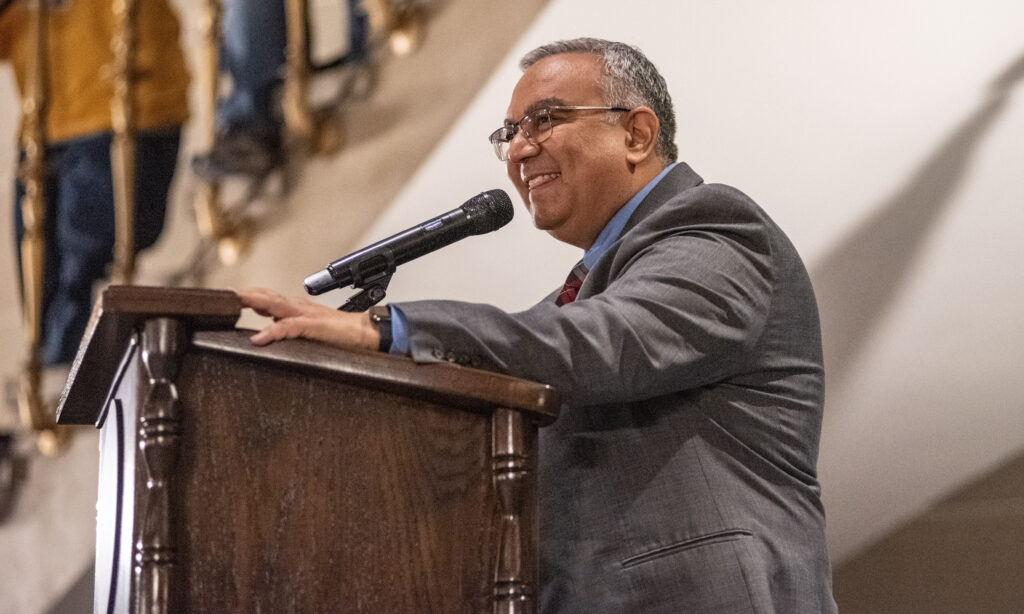
State Treasurer Vivek Malek speaks about the MOScholars program during a rally in the Missouri State Capitol Feb. 26, 2025 (Annelise Hanshaw/Missouri Independent).
The Missouri State Treasurer’s Office inadvertently posted a directory of students enrolled in the state’s private school voucher program on its website for almost a year, even as it repeatedly denied lawmakers’ requests for the same information.
The data, which covered the first three years of the MOScholars program, included students’ names, their parents’ email addresses, scholarship funding amounts and the schools they attend. After being notified by The Independent last week, the treasurer’s office removed the records from its website, which date back to at least May 2025.
The office confirmed in a statement to The Independent Monday that a spreadsheet on its website “could be manipulated” to reveal what it described as “directory information.” This data is “not generally considered harmful or an invasion of privacy if disclosed,” the office told The Independent in an emailed statement.
The treasurer’s office has long maintained that the data is not public and may be withheld under the Missouri Sunshine Law.
“(Organizations facilitating MOScholars scholarships) and families can be confident that the office takes data protection seriously as part of its ongoing efforts to responsibly administer a growing statewide program and will continue to ensure that all sensitive data remains adequately protected,” it said.
The disclosure raises fresh questions about how State Treasurer Vivek Malek’s office is managing MOScholars, a politically divisive program that now receives $50 million in state funding.
The records were contained in a file posted on the treasurer’s website that included embedded data making the student information accessible. The law governing MOScholars requires annual public reporting on certain aspects of the program but says that “no personally identifiable information of any student” may be posted on the treasurer’s website.
State Sen. Rick Brattin, a Republican from Harrisonville and chairman of the Senate Education Committee, called the incident a “massive oversight.” But he stopped short of blaming Malek, who endorsed Brattin’s congressional campaign in March.
“I truly like Vivek. He’s doing a great job for all the tasks that he does have to do,” Brattin told The Independent. “But I do know people are human, and they do screw up, too. But at the same time, regardless of screw ups, we need to make sure that all these things are buttoned down.”
Senate Minority Leader Doug Beck, a Democrat from Affton and frequent critic of the MOScholars program, told The Independent he has asked for a directory of participants but has been repeatedly denied. The treasurer’s office accidentally publishing the data, he said, is part of a pattern of “incompetence.”
“I personally don’t think (the program) should be in the treasurer’s office,” he said. “As we’ve seen, I don’t think they’re capable of running this program.”
This is not the first time information related to MOScholars has been posted online and later been removed. In 2024, The Independent published a story identifying top donors to the program using public data on Missouri’s transparency portal.
The treasurer’s office did not know the information was online and wiped it from the state-run website in a matter of days. Jackson Bailey, the treasurer’s chief of staff, called the 2024 incident a “clerical error.”
Last year, the state auditor’s office reported that the treasurer had failed to conduct annual audits of MOScholars, which is required by state law. Additionally, the audit found the treasurer’s office did not have procedures to “adequately review or monitor annual reports” from the organizations that administer the scholarships.
Malek acknowledged the faults in his response to the audit, saying that the office’s director of programs will improve oversight of the reports from educational assistance organizations.

To Beck, it makes sense not to publish the information publicly on a state website. But he thinks it should be available if someone makes a request under Missouri’s open records law.
“When somebody receives taxpayer money,” Beck said, “there should be some sort of accountability there.”
He has publicly fought with the treasurer’s office over access to records in an effort to determine whether the MOScholars program is serving low-income families or whether, as he puts it, “loopholes” have allowed wealthier families to benefit from state support.
MOScholars has been a point of contention since it was created in 2021, first using a tax-credit model that allowed donors to deduct contributions from their tax liabilities. In 2025, lawmakers voted to infuse the program with $50 million of general revenue, allowing it to triple in size.
To account for this growth, Malek asked for four additional full-time staff members to help administer the MOScholars program in his proposed budget for the next fiscal year.
“Without this request, (the MOScholars Program) will lack adequate staffing to manage program growth and ensure statutory compliance,” Malek’s budget request says.
The General Assembly has not yet finalized the state budget, however the House has voted to authorize the treasurer to hire four additional employees.
Brattin, who has been an outspoken advocate for shrinking state government and cutting what he calls bureaucratic “bloat,” said he would support adding staff if it is necessary for the office to properly run the program.
“The public has an expectation that these offices are able and capable to fulfill their duties,” he said. “I’ll absolutely always defend making sure these offices can operate and have the staff necessary to do so.”
This summer, the office is expected to expand its MOScholars reports to include data on student achievement and parent satisfaction, as required by state law.
Compiling this data is complex, the office said in its emailed statement, because MOScholars students have the option to take dozens of nationally normed assessments to meet the testing requirement. In 2024, the treasurer’s then-communications director, Kern Chhikara, told The Independent that the office needed additional staffers to create the report.
The issues have since been resolved, with St. Louis University’s PRiME Center hired to help aggregate the data, and the office has since hired staff “with expertise in early childhood education, special education and public financial management.”
“While the performance report itself is produced by the PRiME Center,” the statement says. “The office is confident it has sufficient internal capacity to oversee the process, review the results and ensure compliance with statutory requirements.”