Good Day Farm faces second Missouri antitrust lawsuit in two weeks
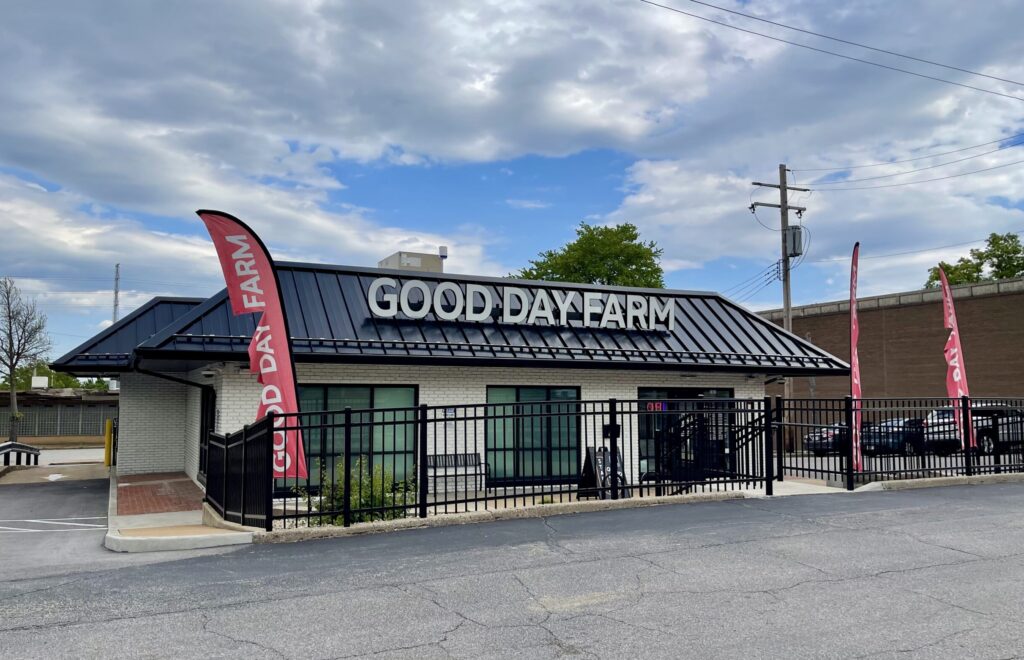
Good Day Farm Dispensary in St. Louis, MO (Photo by Rebecca Rivas/The Missouri Independent)
Missouri’s largest marijuana company is facing a second antitrust lawsuit in two weeks, this time from a Kansas City consumer who alleges Good Day Farm and more than 40 affiliated LLCs used a web of dispensary licenses to limit competition and inflate prices.
Damon Frost Jr., a general contractor in Kansas City, filed the class-action lawsuit in Jackson County Circuit Court earlier this month on behalf of Missouri residents who purchased recreational cannabis products from the defendants.
“Defendants’ illegal scheme has successfully limited choice and locked out third party brands,” the lawsuit states, “thereby decreasing competition and increasing costs for Missouri consumers.”
Frost and class members seek to dismantle the alleged operation and recover damages for consumers.
In a statement to The Independent, Lisa Weser, a spokeswoman for Good Day Farm said the claims in the lawsuit are “baseless and without merit. Our company operates in full compliance with all applicable Missouri state laws and regulations, and we will vigorously defend that record.”
Frost declined to comment about the lawsuit.
This is the second class-action lawsuit filed against Good Day Farm and dozens of affiliates.
The first lawsuit came two weeks ago and was led by two Missouri marijuana manufacturing companies who alleged that Good Day Farm and its affiliates are tied through ownership records, management structures and acquisition agreements to more than 60 of Missouri’s 224 dispensary licenses — more than a quarter of the market.
They’ve used that structure, the lawsuit alleges, to form an “illegal cartel,” coordinating pricing, product supply and retail operations across dispensaries that do not all operate under the Good Day Farm name.
“We will not allow aggressive legal tactics to distract us from what matters most: our mission to deliver uninterrupted service and exceptional products to the patients, customers and employees who rely on us,” Weser said in an emailed statement.
Controlling the market
When Missouri voters legalized recreational marijuana in 2022, the constitutional amendment they approved carried forward a limit meant to prevent any single company from controlling too much of the market.
But one key phrase from the state’s medical marijuana law was gone.
The constitution’s medical marijuana provision barred the state from issuing more than five dispensary licenses to any entity under “substantially common control, ownership, or management.” The recreational marijuana amendment instead says an entity may not own more than 10% of total dispensary licenses, dropping the language covering common control and management.
That change received little public attention during the campaign. But records obtained by The Independent show it helped create an opening for Good Day Farm, the Little Rock-based marijuana company that was the leading donor to the legalization campaign, to build a much larger footprint in Missouri than the state’s license cap might appear to allow.
Good Day Farm first began operating in Missouri in 2020, according to its earliest LLC registration with the Secretary of State.
After the 2022 constitutional amendment passed, company employees registered two additional LLCs — one in November 2022 and another in February 2024 — that went on to acquire 20 dispensaries, two manufacturing facilities and two cultivation sites, according to state business records.
Arkansas marijuana company tied to more than a quarter of Missouri dispensaries
Ownership records the Independent obtained related to Good Day Farm and the LLCs affiliated resulted in numerous “common control affidavits” owners previously had to sign before recreational marijuana passed in November 2022.
Frost argues in his lawsuit that Missouri marijuana laws allow for no more than 22 dispensaries to be under “substantially common control, ownership or management.”
A review by The Independent of publicly-available marijuana business compliance records revealed the state no longer requires owners of licensed dispensaries, manufacturers and cultivators to submit affidavits attesting they don’t share common control or management with other licenses.
When asked about the timing of the affidavits, Lisa Cox, a spokeswoman for the Missouri Department of Health and Senior Services, which oversees the Division of Cannabis Regulation, confirmed that the division “discontinued collection” of that affidavit when the constitution was amended.
“The law and rules do not require analysis for substantially common control or management with comprehensive licenses,” Cox said.
The only exception is testing facilities, Cox said, who must still affirm that they are not under substantially common control with testing labs.
The first lawsuit, filed by Vibe Cannabis and Local Cannabis manufacturing licensees, included an agreement that sheds some light on how the acquisitions of licenses occurred, why there’s so many affiliated LLCs and who actually controls those licenses.
The agreement outlined that outside investors would formally own an LLC that would acquire 10 licenses. However the LLC’s manager, selected by Good Day Farm, would make “all decisions,” including pricing and product selection across the dispensaries.
“The manager and/or its affiliates,” the agreement states, “also operate multiple other dispensaries, cultivation facilities and processing facilities in the Missouri marijuana industry.”
Frost’s lawsuit argues Good Day and its affiliates are violating state consumer protection law, known as the Missouri Merchandising Practices Act.
“All class members have suffered and will continue to suffer injury as a direct and proximate result of the combination and conspiracy between defendants that is ongoing,” the lawsuit states, “and relief will benefit all class members.”
Click on the link at the top of this article to be taken to the complete article.