Missouri AI regulations founder in House committee despite White House go-ahead

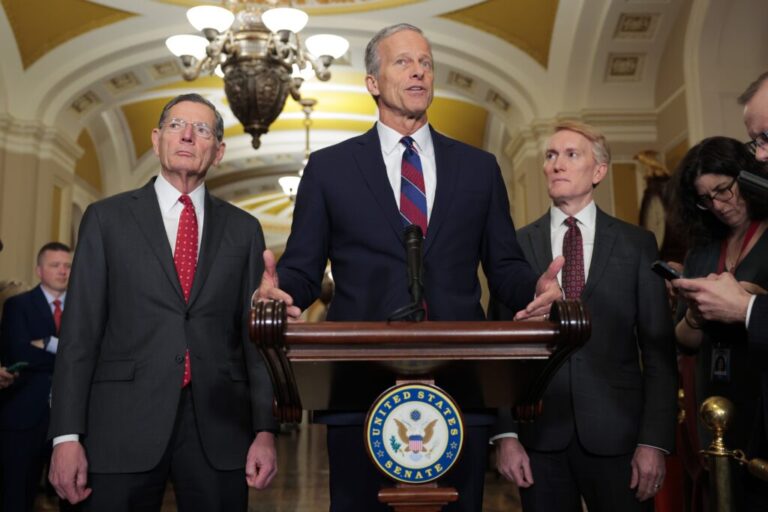
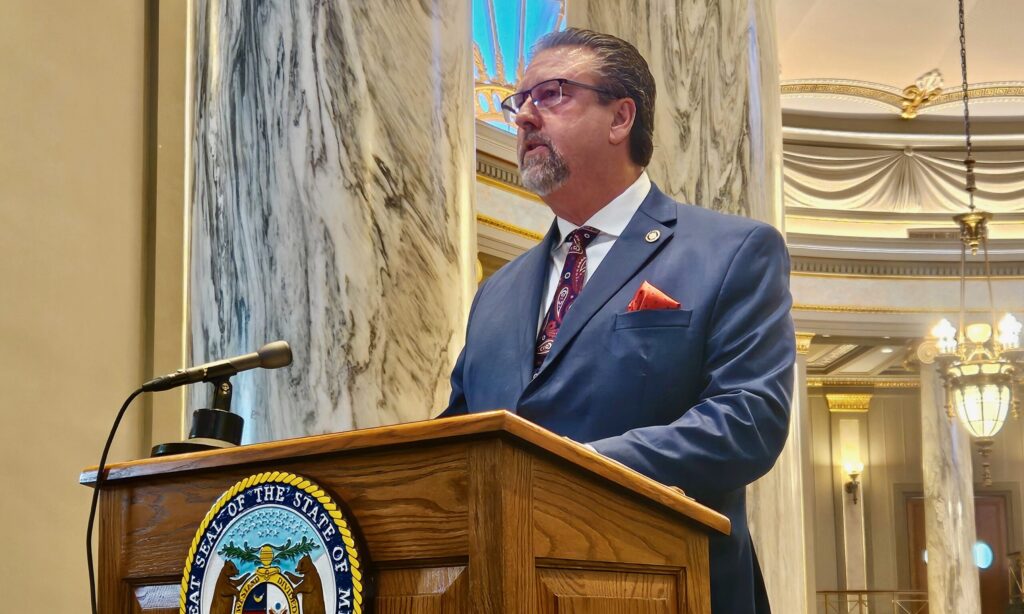
State Sen. Joe Nicola speaks to reporters at a news conference in April about his proposed artificial intelligence regulations (Rudi Keller/Missouri Independent).
A Missouri House committee voted down legislation on Tuesday aimed at establishing safeguards on the use of artificial intelligence over concerns that the bill lacked enforcement mechanisms and included drafting errors.
The bill, sponsored by Republican state Sen. Joe Nicola of Grain Valley, would have specified that liability for harm caused by an AI system always resides with a person or organization.
The 11-0 defeat of the bill came after Nicola dialed back chatbot restrictions and liability guidelines for AI developers at the behest of President Donald Trump’s AI team.
Nicola told The Independent Tuesday evening he had hoped the White House go-ahead would be enough to win his colleagues’ support.
“My hope was that working with the White House and them saying, ‘We’re neutral on it,’… [if] I communicated that to the senators and to the representatives, that that would have made them feel better and more at ease to vote for it,” Nicola said. “But it sure didn’t.”
Republican state Sens. Jamie Burger of Benton and Jason Bean of Holcomb raised concerns last month that the bill could jeopardize nearly $900 million in remaining federal funds for rural high-speed internet expansion by violating Trump’s December executive order on AI.
The executive order indicated that states with “onerous” laws conflicting with “a minimally burdensome national policy framework for AI” would be ineligible to receive “non-deployment” funds set aside for the $42.5 billion federal Broadband Equity Access and Deployment Program.
Though the revised bill passed the Senate last week 20-10, Burger and Bean still voted against it.
Burger said regulating AI development could put U.S. entrepreneurs at a disadvantage.
“I know we need curbs in place at some point in time with AI,” Burger said. “I just don’t know that this is the time.”
In a House committee hearing Tuesday, Nicola said his bill would “clarif[y] that existing law applies to artificial intelligence” rather than creating a new regulatory scheme.
But some said the revised bill leaves it unclear where liability for AI harm resides.
Democratic state Rep. Elizabeth Fuchs of St. Louis asked who would be held responsible for harm caused by the sharing of a false, AI-generated image on Facebook — the person who shared the image or Mark Zuckerberg, the controlling shareholder of the platform’s parent company, Meta.
“You said a person, which I appreciate, but which person?” Fuchs said. “That’s where I’m curious.”
Nicola said that while the “end user” who shared the image wouldn’t be liable in that situation, the state wouldn’t be able to hold Facebook responsible either.
Lobbyists representing Americans for Prosperity and the Missouri Chamber of Commerce and Industry testified against the bill during the House committee hearing, pointing to drafting errors and a lack of enforcement mechanisms.
Nicola’s original bill would have allowed courts to hold parent companies or key shareholders responsible for “significant harm” caused by their products in cases of “reckless, negligent or deceptive conduct.” And it would have required developers of AI systems to report suspected incidents of “significant bodily harm” or property damage due to AI to the Missouri Attorney General for investigation.
The White House pressed for changes to those provisions, Nicola said.
“We had some pretty strong liability in there for developers,” he said, “and they were very concerned about that, so we scaled it all the way back just to state product liability.”
Missouri law allows people to file civil claims against companies for defective products that are unreasonably dangerous, or when companies failed to warn consumers of potential dangers.
Nicola’s bill would have required companies that use AI to interact with customers or patients to clearly indicate when they are interacting with an AI system.
White House staff also asked Nicola to dial back restrictions on AI chatbots, borrowing language from a 2025 California law, Nicola said.
An earlier version of the bill would have required age verification to prevent minors from using AI chatbots and made it unlawful to develop or publish chatbots likely to encourage minors to engage in self-harm or sexual conduct.
The revised version removed age verification requirements and reduced the upper limit on liability from $100,000 to $1,000.
Nicola, who plans to file AI legislation next year if Congress doesn’t act, said working with the White House made his bill “weaker.”
“They wanted me to pare it back,” Nicola said. “…If we’re holding people liable for harm and protecting people, that, to me, makes it stronger.”