Missouri budget earmarks fight becomes part of St. Louis County political battle

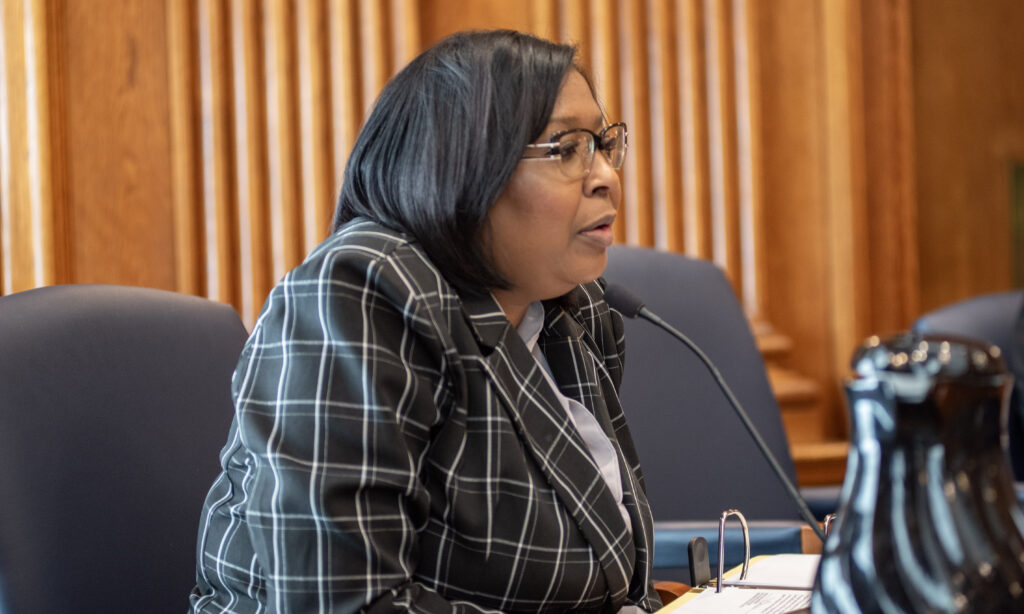
State Sen. Angela Mosley, D-Florissant, asks questions during a Senate Gubernatorial Appointments Committee hearing April 16 (Annelise Hanshaw/Missouri Independent).
Two small community agencies with personal ties to state Sen. Angela Mosley face questions about their budget earmarks in a debate that some involved say is more about St. Louis County politics than the cost in the state budget.
The earmarks — $300,000 for Saving Our Children, which provides a variety of services ranging from summer job placement to daycare, and $100,000 for Red Circle, which concentrates on food access — became part of the state Senate budget proposal late in the process, after the Senate Appropriations Committee had put its impression on the spending plan.
That late addition brought questioning from state Sen. Brian Williams, who is running against Mosley and St. Louis County Assessor Jake Zimmerman in the August Democratic primary for St. Louis County executive.
In an interview with The Independent, Williams, of University City, said the issue was transparency, not the agencies or the amounts involved.
“The appropriation process should always be transparent,” he said. “We should always be clear on what members prioritize certain appropriations or certain budget items.”
Mosley, in an interview, said she didn’t understand why Williams decided to challenge items for organizations working on poverty problems. He has rarely spoken up during floor debate on the budget during her six years in the Senate, she said.
“I can only speculate what his reasons were for speaking at this time,” said Mosley, who lives in Florissant.
The two items are among more than 150 earmarks among the 16 appropriation bills that must be passed by Friday’s constitutional deadline. The earmarks would use $348.3 million, including $164.6 million of general revenue, if all are included in the final spending plan for the year starting July 1.
The total state budget will be about $51 billion, including building maintenance and construction. The general revenue portion will be about $16 billion.
Earmarks are becoming harder to insert in the budget because estimates made in December warned revenue would decline during the current fiscal year. Kehoe’s budget estimated in January that only $265 million would remain in the general revenue fund on June 30, 2027.
Through Friday, general revenue is down 2.6% for the fiscal year.
In his questioning of earmarks, Williams worked down a list of a dozen items added late. He wanted to know who had asked for each one. The two associated with Mosely took the longest to reveal.
Saving Our Children, which received its earmark money from a national settlement with opioid makers, employs Mosley’s daughter, Janay Mosley, and Red Circle, which received $100,000 of general revenue, employs her sister, Rochelle Walton Gray, a former state representative and St. Louis County council member.
Alena Malone, executive director of Saving Our Children, said Williams’ questioning was intended to embarrass Mosley and deny her agency vital community funding.
Malone said she is certain that politics, not a demand for transparency, motivated Williams.
“You can tell that the tactics behind the whole conversation on that floor was geared for and aimed at getting to our line item,” Malone said. “It was to get to anything, to be honest with you, from what I know, it was to get to anything that Sen. Mosley might have a connection to.”

Williams said he didn’t know anything about the program, Malone said. She visited him in his office to explain their work, she said.
During the debate, state Sen. Rusty Black, chairman of the Senate Appropriations Committee, said representatives from Kehoe’s office, not Mosley, asked him to insert the funding for Saving Our Children.
Kehoe has praised Malone’s work and brought her to Jefferson City for his 2025 State of the State address to highlight a new child care center and her leadership at Saving Our Children. The organization received $1 million in funding in this year’s budget, $500,000 from federal welfare funds and $500,000 from opioid settlement funds, and Kehoe recommended the same in the current budget.
House Budget Committee Chairman Dirk Deaton, a Republican from Seneca, cut the welfare funds. When the committee met to finish work in March, state Rep. Raychel Proudie, a Ferguson Democrat, amended the budget to cut the opioid funding.
During committee discussions, Proudie accused Malone of taking $200,000 of the $1 million in funding from the current budget for her salary, citing memoranda signed with the state on the use of the funds. But the organization’s IRS filings show her salary is approximately $93,000.
That criticism led to an audit of their program, Malone said, which it passed. Only about $50,000 of the state funding went to her salary, she said, as part of administrative expenses to oversee use of the money.
“They were mad at me because the governor honored me and I accepted his honor, and in me, accepting that honor, they said I was his Black face,” Malone said.
Malone said she appealed to Kehoe’s office for help.
“I went to the governor’s office and I told them what was going on,” Malone said. “They said it probably was nothing that they could do to stop it from getting taken out of the budget at the House level, but it would try to get it put back in on the Senate level.”
The political rivalries involved in the appropriations go deeper than the primary for St. Louis County executive. Janay Mosley, who oversees the use of welfare funding for Saving Our Children, is running for the second time in the 68th House District against state Rep. Kem Smith, and Theresa Hester, deputy executive director, filed in the primary against state Rep. Marlene Terry in the 66th District.
Williams denied there was a political motivation in his questions.
“It’s not about supporting an organization, it’s about a transparent process, and if Sen. Mosley supports that organization, I think it’s good for St Louis,” Williams said. “Our job is to look at opportunities to advance our communities and our region and not just pet projects.”
Late in Williams’ questioning of the earmarks, Mosley acknowledged she requested the money for Red Circle. She abstained from voting on the spending bill.
All the agencies Williams questioned work on poverty and other issues in low-income communities, Mosley said.
“They are the ones that are the boots on the ground,” she said.
State Sen. Karla May of St. Louis, who lobbied successfully for several earmarks, said she noticed that the subtext of Williams’ inquiry seemed to be intended to gain an advantage in the primary.
“It’s going to be,” May said, “an interesting race.”
GET THE MORNING HEADLINES.