Tariff refunds have just begun, but Missouri’s winners and losers are already emerging

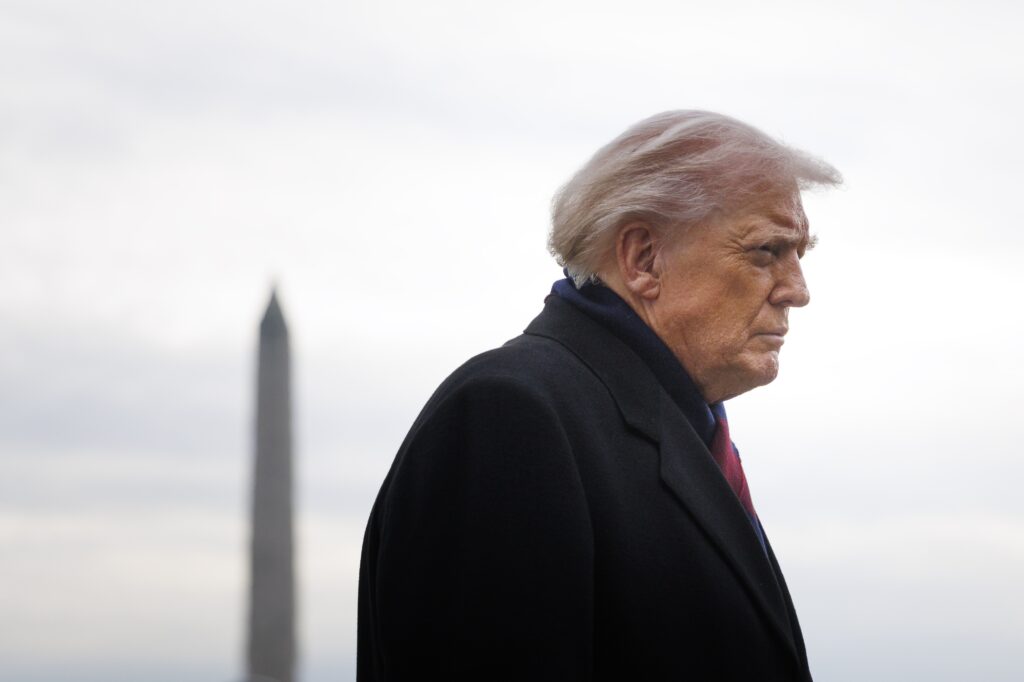
President Donald Trump speaks to reporters before boarding Marine One on the South Lawn of the White House in December 2025 (Tom Brenner/Getty Images).
Missouri businesses may soon begin applying for billions in tariff refunds after a recent U.S. Supreme Court ruling, but who actually benefits is already becoming clear.
Last week, the federal government took its first step toward issuing refunds, launching a portal through U.S. Customs and Border Protection (CBP) that allows companies to apply for reimbursement of tariffs collected under the now-overturned policy. The February decision found that the administration exceeded its authority under the International Emergency Economic Powers Act (IEEPA) by imposing sweeping tariffs on imports from more than 100 countries.
Estimates indicate that up to $166 billion in tariffs, plus interest, could be refunded. Over 330,000 importers paid these tariffs on tens of millions of shipments. While this decision enables refunds, it also introduces a challenge: how to reverse complex tariff payments processed through intricate supply chains across multiple countries. Additionally, even if businesses receive refunds, consumers who paid higher prices are unlikely to benefit.
Currently, refunds are issued only to the importer of record (IOR), not necessarily to the businesses that purchased the goods or to consumers. This could significantly impact smaller companies, as many do not act as their own IOR and instead rely on third parties such as customs brokers, freight forwarders, or large distributors to handle imports. These third parties may claim refunds, even if the smaller businesses ultimately bore the higher costs. Consumers, further removed from the process, paid higher prices during the tariff period but are not eligible for refunds under the current system. It will depend on IORs whether those funds are passed on to customers; UPS has announced it will do so, but others have yet to decide.
For Missouri businesses, the Supreme Court’s ruling has brought a measure of clarity to an otherwise volatile trade environment, but it has not eliminated tariffs.
By declaring tariffs imposed under emergency powers unlawful, the court reinforced clearer legal boundaries around trade policy after months of shifting rules. For some Missouri companies, particularly larger manufacturers and importers, the potential for refunds could provide meaningful financial relief by helping offset past costs and improving cash flow.
That relief, however, is unlikely to be evenly distributed across the state.
Many smaller Missouri businesses, including retailers, construction suppliers, and independent manufacturers, do not serve as the IORs and instead rely on third-party importers or customs brokers. As a result, they may be ineligible for refunds or face significant hurdles in recovering costs they ultimately absorbed.
At the same time, tariffs themselves are not going away.
The administration has shifted to other authorities, including Section 122 of the Trade Act of 1974, to impose a 10% global tariff that could rise to 15%. Additional measures under Section 123, along with existing tariffs on steel, aluminum, and other sectors, remain in place.
For Missouri, that means the industries most central to the state’s economy remain exposed to ongoing trade restrictions.
Agricultural exporters, including soybean and corn producers, depend heavily on stable global markets. Manufacturers, from industrial firms in St. Louis to suppliers across the state, rely on imported components and cross-border supply chains. The construction and housing sectors are already facing higher costs due to tariffs on materials such as steel and lumber. Retailers and restaurants continue to contend with higher prices on imported goods.
Missouri’s exposure to these shifts is amplified by its strong trade ties to Canada and Mexico, its two largest export markets. Together, they account for more than half of the state’s outbound trade, and many industries, including agriculture, manufacturing, and automotive supply chains, depend on relatively seamless cross-border movement under the United States-Mexico-Canada Agreement (USMCA).
For Missouri industries, the result is a policy environment that is more clearly defined legally, but still economically unpredictable, particularly for businesses tied to global supply chains and export markets.