On sentencing reform, Missouri can be the Show-Them State

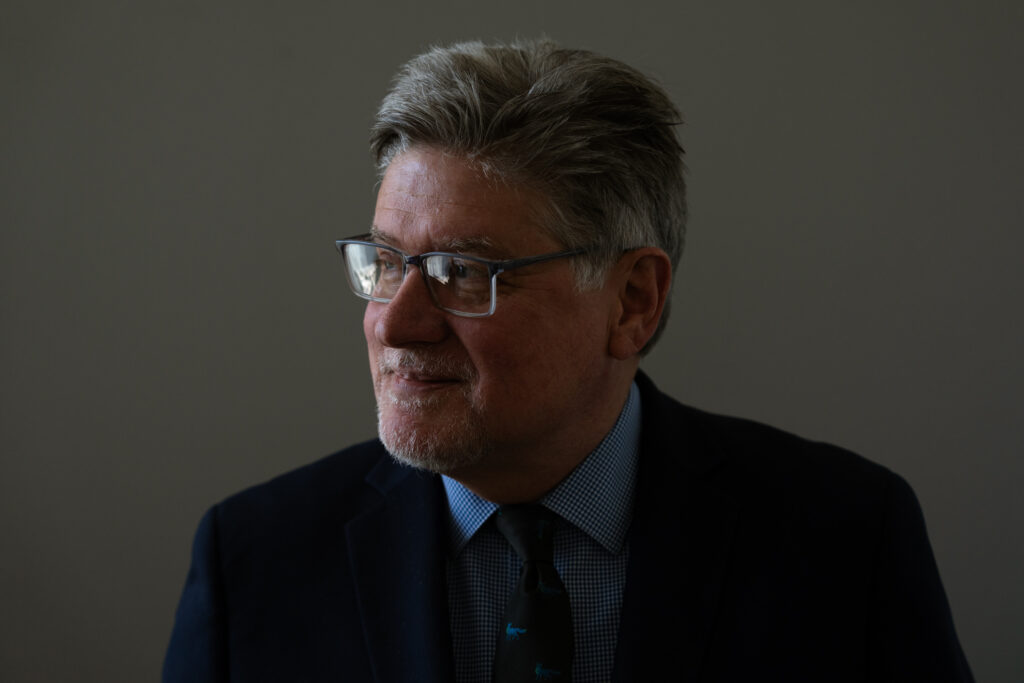
Doug Burris, St. Louis’ interim Commissioner of Corrections, on Monday, March 10, 2025, at St. Louis Public Radio in the city’s Grand Center neighborhood (Brian Munoz/St. Louis Public Radio).
Missouri’s moniker as the Show-Me State is said to originate from a Congressman who said that his midwestern roots preferred evidence over eloquence. “I am from Missouri,” he is purported to have said. “You have got to show me.”
Now, 127 years later, Missouri can show other states — and the federal government — how its criminal justice and public safety reforms have borne fruit. That opportunity comes with federal legislation called the Safer Supervision Act. The bill, according to its sponsors, “reins in the federal supervised release system and ensures it is focused, effective, and accountable to taxpayers.”
In short, the sponsors argue the current federal system relies too heavily on supervised release. This creates an unmanageable workload for federal probation officers. As a result, too little attention is paid to supervising high-risk individuals, where it is most needed. Their bill seeks to discern between those who need close supervision and those who do not—allowing resources to be allocated more effectively
I spoke with Doug Burris, who was described just last month by St. Louis Magazine as “something of a jail turnaround artist.” From 2000 to 2018, Burris served as Chief U.S. Probation Officer for the Eastern District of Missouri and then two short stints as Director of St. Louis County Justice Services. He recounted that in the early 2000s the Missouri Department of Corrections was failing on several fronts.
“The state prison population was increasing,” he said, “and many of those released to the community experienced a revolving door back to incarceration.”
They returned not because of new violence or criminal behavior, but because of technical violations of their probation.
The result was not only an increase in the workloads of probation and parole officers, whom Burris describes as doing heroic work, but more Missouri families dependent upon state assistance programs when their primary provider went back to prison. Missourians were paying twice: once to lock up people for small infractions, and second to support the families they left behind.
And it appeared it might cost taxpayers a third time. By around 2012, said Burris, “some people projected needing to build a new prison in order to keep up with demand.”
Thankfully, according to Burris, legislators in Missouri took action that became a model for others. HB1525, adopted in 2012, streamlined the system by creating clear incentives that moved low-risk, compliant individuals off supervision faster. The effort succeeded because, as Burris said, “legislation followed the science of criminal behavior and how to deal with it.” The state was able to reduce the number of people in the criminal justice system by 18 percent without any negative implications for public safety.
Later, in 2018, Missouri passed HB1355, which among other things, tightened supervision standards by requiring better risk assessments. It expanded treatment-focused responses where needed and focused resources on higher-risk individuals. This effort also proved successful because, as Burris notes, “It allowed probation and parole officers to become more effective by assessing risk, using alternatives to reincarceration and focusing on those most likely to reengage in criminal activity.”
It is not often that government initiatives work as intended, but it is gratifying when they do.
Incidentally, to their credit, current U.S. Reps. Eric Burlison and Jason Smith voted in favor of HB1525 when they served in the Missouri House. (U.S. Sen. Eric Schmitt was absent on the day it was approved in the state Senate.) In 2018, current U.S. Rep. Bob Onder voted for HB1355 in the Missouri Senate.
Burris said other states “have not been quick to follow Missouri’s lead.”
He points to one neighboring state constructing a new 3,000-bed prison, at a price estimated to exceed $1 billion, not counting the ongoing costs to operate the facility. Missouri currently averages $100 daily to incarcerate an inmate, meaning that had Missouri not reformed our system, taxpayers would be paying in excess of $100 million annually to maintain a similarly sized prison.
In reforming its parole system, Missourians did well by doing good.
When he served as Missouri Treasurer in 2017, Schmitt told a Show-Me Institute audience about the reforms enacted by the state legislature in the aftermath of the Ferguson riots. He said, “We did something in Missouri that is being replicated in other places now.”
That should be a source of pride — even if born of tragedy.
So, too, with federal probation guidelines. Missouri and its legislators should be proud of what was accomplished in 2012 and 2018, and we should be eager to support those same reforms at the federal level.
“We are from Missouri. We have something to show you.”