Missouri first responders’ naloxone distribution efforts face potential budget cuts

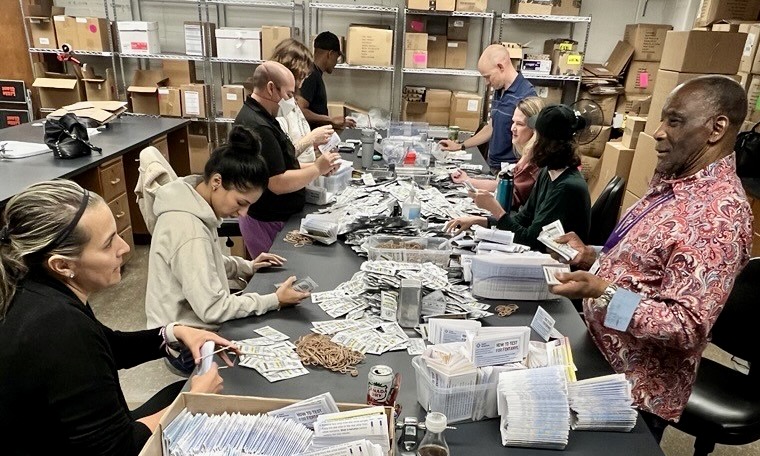
Volunteers and staff from the Addiction Science Team at the University of Missouri-St. Louis package naloxone and other community health supplies for statewide distribution in early 2025 (Photo submitted).
When paramedics from the St. Charles City Fire Department arrive at the scene of an opioid overdose, patients refuse to go to the hospital about 75% of the time.
But even if they decline treatment, they’re likely to accept naloxone kits that paramedics leave behind, said Marc Doll, emergency medical services bureau chief for the department.
First responders are ideally placed to distribute the medication, Doll told The Independent, which quickly reverses opioid overdoses to those who need it most.
“We’re going to be the ones that have the best contact time with people that are at their most vulnerable, when they’re more likely to accept the help so that we can give it to them,” he said.
The Senate Appropriations Committee on Tuesday recommended cushioning the blow of a funding cut passed by the Missouri House for naloxone distribution by first responders, restoring $5 million. The efforts are still facing a $3 million reduction from the current fiscal year.
Since Missouri began receiving settlement funds from the nation’s top opioid producers and distributors in 2023, the Missouri Institute for Mental Health at the University of Missouri-St. Louis has used some of that money to distribute naloxone throughout the state. In 2025, the institute gave out more than 1.2 million doses of naloxone. Each kit contains two doses of the medication, instructions for its use and a list of resources for people seeking help for opioid use disorders.
The Senate plan would partially restore the funding by drawing from the state’s opioid resettlement fund. Republican state Rep. Dirk Deaton of Seneca, chair of the House Budget Committee, opposed an amendment seeking to restore some of the naloxone distribution funding in the House last month, citing the need to preserve opioid settlement funds for future years.
If the committee votes to approve the plan, it will go to debate by the full Senate.
Rachel Winograd, director of addiction science at the institute, which is the state’s sole contracted purchaser and distributor of naloxone, told The Independent that while she sees the move as a “meaningful step forward,” a $3 million cut would still be significant.
“Any meaningful restoration of naloxone funding in Missouri saves lives,” she said. “At the same time, any cut to this funding has real consequences.”
Doll said naloxone availability is crucial to getting people into treatment and recovery.
“Dead people don’t get into long-term recovery,” he said.
Opioid settlement funds
Since 2023, Missouri has received $213.5 million in opioid settlement funds.
The number of Missourians who died from an opioid overdose decreased by 42% between 2021 and 2024, from a peak of 1,581 to 910. Between 2024 and 2025 alone, the number of opioid overdose deaths declined by more than a third.
Gov. Mike Kehoe recommended keeping naloxone distribution funding flat at $13.1 million for fiscal year 2027, with $8 million for first responders and $5.1 million for other naloxone distribution efforts.
During House debate in March, Democratic state Rep. Kimberly-Ann Collins of St. Louis sponsored an amendment that would have restored $6.5 million for naloxone distribution.
Collins told The Independent that naloxone distribution funds “have everything to do with supporting individuals with substance use disorders.”
But Deaton opposed the amendment because it would have required appropriating additional money from the state’s opioid resettlement fund, instead of moving funds from elsewhere in the budget.
Deaton also said there is already a saturation of naloxone in Missouri.
“I’ve not heard anybody across the state or any provider that they suffer from a lack of naloxone availability,” Deaton said. “If anything, it’s actually the opposite. I’ve heard reports of…naloxone being discarded because it’s expired.”
Doll said the availability of naloxone in the state is why overdose deaths are decreasing.
“Now that we have that Narcan out there in the communities, because it’s ‘sitting around everywhere,’” Doll said, “…those Missourians now are not dying at the rate they were. And so the question is, do we want to protect those people or not?”
And 79% of the naloxone the institute distributed in fiscal year 2025 went to 563 organizations that requested routine shipments because their supply runs out, according to a report by the institute.
The amendment failed on a 60 to 74 vote, with 14 Republicans in support.
Lawmakers reduced naloxone distribution funds during the House committee mark-up process, after public hearings on Kehoe’s budget recommendations were over.
Jason White, EMS program manager for the Mid-America Regional Council, told The Independent many first responders felt blindsided by the change, since Kehoe hadn’t recommended a cut.
“If you know that it’s not in the governor’s budget…then you can react to it and say, “Maybe not a great idea. Let’s talk about that,’” White said. “And the last minute inclusion of those cuts left no ability to engage in the budget conversations on the House side.”
‘Saving each other’s lives’
The U.S. Food and Drug Administration approved naloxone for over-the-counter use in 2023. But at around $50 for two doses, Doll said it’s too expensive for people who are using drugs regularly to purchase from pharmacies.
“Their money’s not going to be going there,” Doll said.
First responders said the increased availability of naloxone has transformed their work.
Around 2020, Doll said, St. Charles sometimes had 50 overdose calls per month. Now it’s rare for the city to have more than five.
Sarah Czarnecki, mobile integrated health battalion chief for the Lincoln County Ambulance District, told The Independent the county had 23 and 24 overdoses in 2022 and 2023. In 2025, that number was in the single digits.
It’s also much more common for bystanders or police to have administered naloxone by the time paramedics arrive, Doll said.
Paramedics check the patient for injuries and hook them up to a respirator to quickly get oxygen to their brain. Once the patient has regained consciousness, they offer to take the person to the hospital or connect them with substance use treatment or wraparound services.
Even if patients decline services, Doll said, they’re likely to accept naloxone kits that paramedics leave behind.
“We’ll talk to a family member that’s there, the other person that was using with them,” Doll said. “We’ll leave it with them and say, ‘Hey, if you change your mind, you can always call us back.’”
Czarnecki said the number of overdose calls her ambulance district receives has decreased over the past few years. While it’s difficult to say for sure, she thinks it’s because people are administering naloxone.
And while paramedics recommend calling 911 even if someone has had naloxone and regained consciousness, Czarnecki said this pattern shows that naloxone works.
“People are saving each other’s lives.”
Winograd said she won’t stop raising awareness about these lifesaving efforts until full funding is restored.
“These are not taxpayer dollars,” Winograd said. “This is big pharma money that came back to our state that we should put back into families and communities to help save and improve lives. We have a moral obligation to do that.”