Missouri House Democrats struggle to match GOP’s fundraising machine

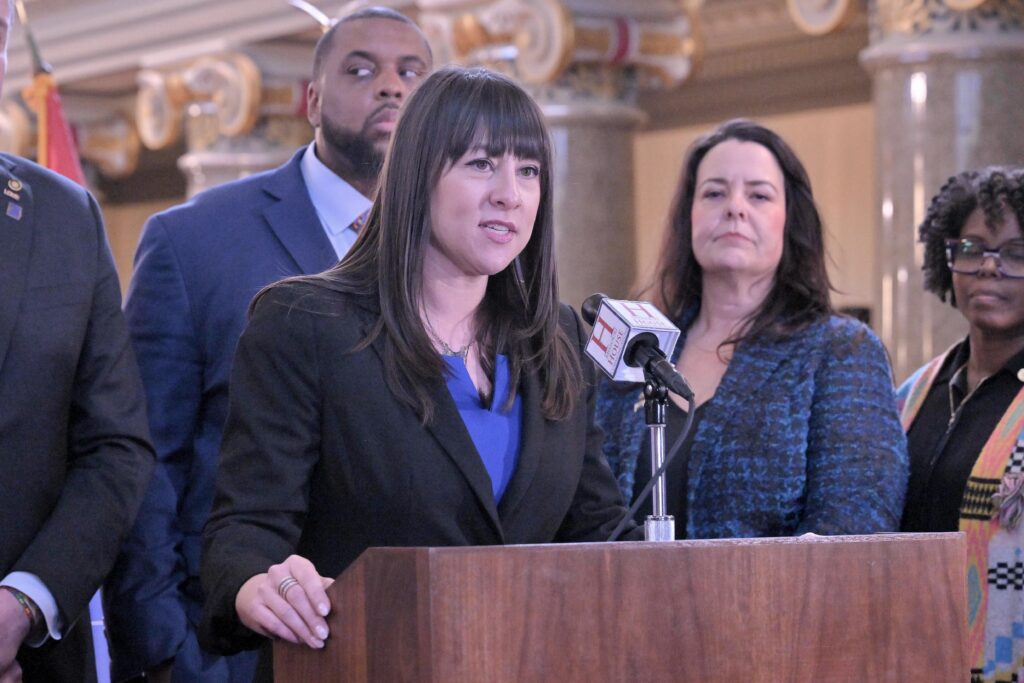
House Minority Leader Ashley Aune, a Kansas City Democrat, says she is trying to convince more Democrats to help flip GOP seats in the Missouri House (Tim Bommel/Missouri House Communications).
For more than 20 years, Republicans have won every Missouri House race in St. Charles County.
It is one of two counties in Missouri with more than 150,000 people — the other is Jefferson — with no Democrats in the local legislative delegation. And it is one of the places Democrats need to win to break the GOP supermajority in the 163-member House.
The county’s closest House race in 2024 was in the 105th District. Republican Colin Wellenkamp defeated Democrat Ron Odenthal by six percentage points to win an open seat. Odenthal’s campaign committee spent $37,298, almost double the $19,832 spent by Wellenkamp.
But an independent committee dedicated to helping Republicans, the House Republican Campaign Committee, spent almost $150,000 in the race. The House Democratic Campaign Committee, as it was then called, countered with less than $15,000.
The disparity is part of a larger pattern in Missouri House politics. Republicans have spent years building a coordinated campaign apparatus financed by sitting members and aimed at holding difficult seats, while Democrats have lagged in creating a comparable system.
“We’re aware that the Republicans have built this machine over the last couple decade or two, and they’re very efficient at what they do, and the Democrats are behind on that,” said Don Crozier, campaign treasurer for Democratic candidates in four districts and a candidate himself in the 103rd District.
The HRCC, as it is known in political circles, spent $2.9 million in 2024 and raised $1.8 million from House Republican incumbents.
The Democratic committee, in contrast, spent $772,000 and raised $205,000 — just 25% of the total — from sitting House members.
The same pattern is playing out again this cycle.
Since the start of 2025, Missouri Ethics Commission records show, 68 of 106 incumbent House Republicans have donated $667,336 to the HRCC, almost 35% of the money raised by the committee. The Democratic counterpart, rebranded for this year’s election as the House Democratic Action Fund, has received contributions from only 19 of 52 incumbent Democrats.
Incumbents have given less than 8% of the $584,000 the committee has raised.

“That’s one of the things that we have on the Republican side that allows us to compete in a lot of districts that, on paper, it doesn’t look like we should win,” said House Majority Leader Alex Riley, a Springfield Republican.
Democrats won 52 seats in 2024, the same number as 2022. Democrats flipped one Republican seat in 2024, but the victory was offset by a Republican flip.
The result defied the optimistic forecasts from party leaders who said Democrats would gain five to seven seats by winning voters who also backed abortion rights and a higher minimum wage as they flooded the polls.
Many who voted to approve those measures, however, voted Republican in partisan races.
If there is an early sign of progress for Democrats this cycle, it came at the close of filing last week, when the party fielded candidates in 157 of the 163 House districts. Over the past 20 years, the party has left an average of 43 House seats uncontested in each election cycle.
Democrats are once again talking about gaining the three seats needed to break the supermajority, but party leaders are avoiding specific predictions
“I got in big trouble last cycle by pontificating about how many seats we would flip,” said House Minority Leader Ashley Aune of Kansas City. “So I’m not going to do that, but what I will say is I have every intention of breaking the super majority and then some this year.”
Battleground districts
Republicans gained the majority in the Missouri House in the 2002 election, ending almost 50 years of Democratic dominance. It became a supermajority in 2012, when the GOP won 111 seats.
Democrats fell to their lowest point two years later, taking only 44 of 163 seats. Nearly all the Democrats live in major cities like St. Louis, Kansas City, Springfield and Columbia. Expanding the party’s appeal beyond major population centers will be necessary to reach the goal of 55 seats that breaks the supermajority.
At the end of filing last week, 73 House Republican incumbents were running for reelection along with 39 Democrats. Of the other 51 districts, 32 incumbents must leave office due to term limits, 14 members are retiring or seeking other offices and five seats, all won by Republicans in 2024, are vacant.
There are 28 seats held by Democrats with no Republican filed. Democrats left only six seats unchallenged.
Filing candidates in every district will force Republicans to play defense more, Aune said.
“It really should scare the heck of Republican incumbents who aren’t used to working for reelection,” she said.
Democrats have not won a statewide race since 2018 and haven’t won the governorship since 2012. The party’s candidates are uncompetitive in rural Missouri and the party’s statewide structure has dwindled since it won every statewide race and held legislative majorities in the 1990s.
The possibility of breaking the GOP supermajority has drawn national Democratic interest to Missouri, Aune told reporters last week.
“We have had a huge atrophy of the Democratic infrastructure in this state, and I’m really proud of the fact that the work that we’ve done in the last year and a half has brought national stakeholders to the table,” Aune said. “They see the opportunity here.”
In the past, the party’s weakness left candidates in swing districts relying on their own fundraising and whatever help the local party can provide, Crozier said. That’s beginning to change, he said, but he’s not ready to say it will make the field equal to Republicans.

The only Democratic districts in southwest Missouri are in Greene County, where Springfield state Rep. Stephanie Hein won her second term in the 136th District in 2024 with 51% of the vote.
Hein spent $159,000 from her campaign fund, while her opponent, Jim Robinette, spent just under $66,000.
The HRCC weighed in with $180,000, half of it attacks on Hein and half of it to promote Robinette. The House Democratic committee spent less than $10,000 in the race.
Democrats in past races have relied on their own resources because there’s little help from the state level, Hein said.
“The expectation is that you’re calling people directly and getting that support directly, as opposed to having one large entity that just takes care of that for you,” Hein said of campaign fundraising. “So you really have to run your own race.”
Having funds to target a district with direct mail and multimedia advertising has been essential to sustaining the supermajority, Riley said.
“Every year that I’ve been here, we’re projected to lose a bunch of seats going into the cycle, and then every year we over perform expectations,” Riley said. “We’ll over perform expectations again this year.”
Campaign relationships
Candidates for the Missouri House may accept contributions of up to $2,000 before the primary election and, if nominated, another $2,000 from the same donor for the general election.
Candidates cannot coordinate their messaging with outside groups if the cost would make it an illegal in-kind donation in excess of the limit. To get around that law, many candidates arrange for the creation of political action committees that can accept unlimited donations.
Candidates can help the PACs raise money but have no say in the message. In this year’s elections, 44 incumbent Republican House members have PACs registered to support them while 10 Democrats have the same arrangements.
Both the House Republican Campaign Committee and the House Democratic Action Fund are officially PACs and candidates have no control over the message being delivered on their behalf.
While the chief criticism of the Democratic effort has been its absence, HRCC’s campaign tactics have angered Democrats for its aggressiveness. In 2018, Michela Skelton, a Democratic candidate running in Boone County, unsuccessfully sued the HRCC for an ad labeling her as an advocate “for violent protest against police.”
There is an upside and a downside to running without being able to rely on a central fund to help, Hein said.
“I control everything that comes out of my campaign,” she said. “I control the messaging. I control what people see. I control how it’s marketed, and no one else can impact my brand because of that.
“I control it, you know, but the resources are difficult to come by.”
Hein established a PAC to help with this year’s campaign, but it raised less than $1,000 in 2025.
The HRCC has been working in a similar way for more than 20 years. When there were no campaign limits, its spending was often reported as an in-kind donation by individual candidates.
But the key to amassing funds, Riley said, has been GOP lawmakers willing to part with money they have raised for the good of all.
Democrats have had the model in front of them for 20 years but haven’t used it.
“I don’t know why they don’t,” Riley said. “You’d have to ask them.”
The results are clear.
“That’s what allows us to govern and do the types of things that we as a Republican majority want to do,” Riley said.
Internal criticisms
In late 2024, former state Rep. Justin Sparks, a Wildwood Republican accused GOP House leadership of selling chairmanships for contributions to the HRCC.
Sparks, a member of the Missouri Freedom Caucus, was challenging state Rep. Jon Patterson of Lee’s Summit, for the position of House speaker. Every new member is told the amount they must contribute to secure plum assignments, Sparks said in a video quoted by the St. Louis Post-Dispatch.
“Mine was $20,000. That’s what I was being required to give to the House Republican Campaign Committee in order to buy my position on powerful committees and to possibly be in leadership one day,” Sparks said in the video.
The video is no longer online.
In 2023, Sparks gave the HRCC a single donation of $1,675 from personal funds. During 2024, Patterson gave $70,000 from his campaign account and another $150,000 from the PAC supporting him, Missouri Alliance.
Riley gave $34,675 in 2023 and almost $73,000 in 2024. He donated $75,479 in 2025 and is expected to be elected House Speaker for 2027.
Riley denied that donations are mandatory.
“Every member is given an ask of saying, like, hey, we’d love it if you’d be able to do this to help out the team,” Riley said. “But it’s not any sort of requirement.”
State Rep. Don Mayhew, a Republican from Crocker, said he has raised very little money to retain his safe seat in south-central Missouri and didn’t see why he should donate much to the HRCC.
“A lot of my campaign contributions come from just regular people,” Mayhew said. “Well, they expect you to use that for your campaign.”
Mayhew said he supports Republicans in competitive districts by knocking on doors and making telephone calls on candidates’ behalf.

Mayhew will have to raise much larger sums this year as he pursues the Republican nomination in the 16th state Senate District, but said rural Republicans can win House campaigns and spend $20,000 to $30,000.
He doesn’t see much chance of rural districts flipping to Democrats.
“Most of your rural legislators, especially in my part of the country, don’t have much to worry about,” Mayhew said.
Within the Democratic Party, Aune said she’s trying to get members to share some of their campaign funds.
Democratic members of the House have raised $1.7 million, an average of $32,402 each, since the start of 2025. Members had $2 million in campaign and PAC accounts on Dec. 31.
Republican members have raised $6.7 million, or an average of $63,134 each, and their accounts held $9.1 million in campaign and PAC accounts at the end of the year.
The House Democratic Action Fund was holding $404,000 at the end of the year while the House Republican Campaign Committee had $1.6 million.
Aune’s campaign committee gave $20,000, almost half the total the committee raised from sitting House members.
“I’ve been trying to build the infrastructure within the House Democratic Action Fund organization that will both encourage and incentivize members to buy into the work that we’re doing, while also putting together the infrastructure that we need to do that work,” Aune said. “And so it is a slow process.”
Black Missourians are a key constituency for Democrats and about 40% of the party’s House members are Black. Those members need assurance that money they donate won’t just be used outside their districts, said state Rep. Michael Johnson of Kansas City, chairman of the Legislative Black Caucus.
Johnson has not made a donation to the House Democratic Action Fund but said he intends to. The effort is showing promise, Johnson said, but needs more work.
“One of the things that we’re trying to make happen is the fact that there has to be more equilibrium in that process, meaning that we have to do a better job of working together,” Johnson said.
The best help for St. Charles County Democrats, Crozier said, is for Democrats in Jefferson City to start working together. Aune identified the problem, he added, when she said the state party structure has atrophied.
“I certainly,” Crozier said, “can’t disagree with that.”