Missouri patients don’t know who to trust when it comes to menopause hormone therapy

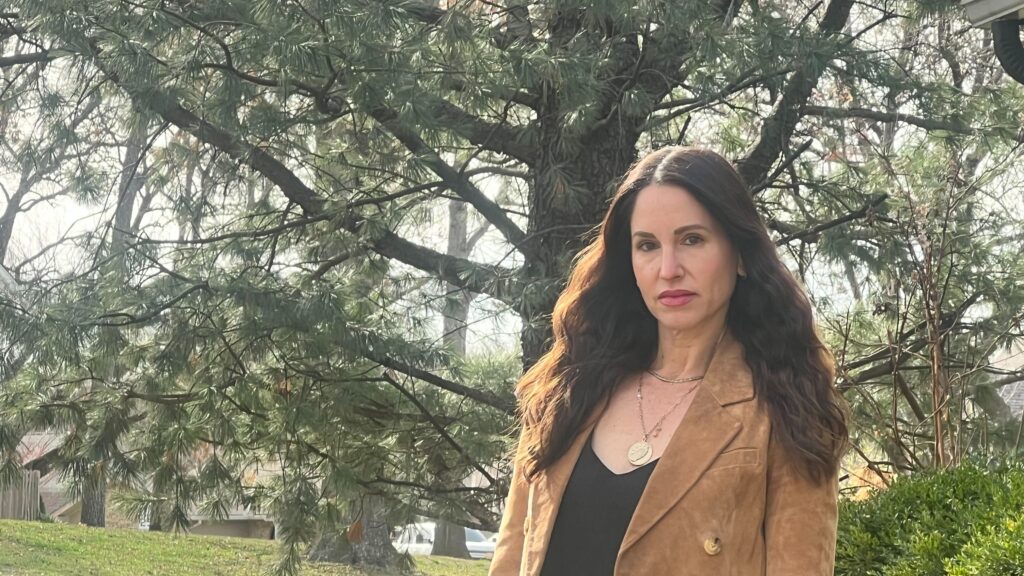
In 2023, Sloane Heller was diagnosed with Atypical Lobular Hyperplasia, a condition that puts her at a 40% risk of developing breast cancer. At the time, despite severe perimenopause symptoms impacting her quality of life, her doctors marked her chart “patient cannot be on HRT” (photo submitted).
Sloane Heller woke up one summer morning in her suburban Kansas City home in 2023 with a loud internal alarm.
“I didn’t feel like I’m in my own body,” Heller said.
Across the state in St. Louis, mother of two Niya Foster was experiencing something similar: sudden shifts in her mood, her menstrual cycle and her mental health.
“I felt crazy,” Foster said.
At the time, neither woman had a name for what they were going through. But their experiences reflect a growing recognition of the difficult-to-describe hallmark of perimenopause — the years-long transition before menopause when hormone levels fluctuate unpredictably. This window of time can last up to 10 years, and until a person has stopped menstruating for one full year.
This transition is described as “a time of hormone volatility”, said Dr. Bret Gordon, a board certified OBGYN and Menopause Society certified provider at St. Luke’s Hospital in Kansas City. This hormonal rollercoaster ride can cause an array of symptoms that go far beyond the well-known hot flashes and night sweats.
For Michelle Renee Holland of Richmond, Missouri, those symptoms have been so severe they have kept her at home.
“The way I describe it to people, I’d be sitting there and it felt like someone took a pan of hot water and slowly poured it over my head,” she said. “It just slowly seeps down my body. It’s embarrassing because I sweat like a man.”
Now nearly a decade into menopause, Holland said the symptoms that began during perimenopause have remained disruptive.
“It’s uncomfortable, stressful, I get upset. I don’t want to go anywhere,” she said. “There have been several times when we’re getting ready to go and I have to start all over and I just tell my family to go without me.”
Missouri legislators are considering a bill that would require insurance coverage for FDA approved treatments for menopause symptoms. It’s an emerging medical topic that’s taken popular culture and the health care industry by storm.
The bill, sponsored by Sen. Patty Lewis, a Democrat from Kansas City, would address access in a state where women face a patchwork of care shaped by conflicting guidance on hormone therapy, uneven physician training and limited access to specialists — especially for those relying on insurance.

While Holland, Heller, and Foster have reliable insurance coverage, their access to menopause support has been anything but. Both Holland and Heller have pre-existing medical conditions that have led to their health care teams at St. Luke’s and University of Kansas Hospital in the Kansas City metro area to discourage menopause hormone therapy, including estrogen.
Foster said her doctors never mentioned hormonal changes could be the culprit for her symptoms.
Interviews for this story — and in anecdotes shared through online forums, friends and family — revealed a pattern: many women described either pushback from doctors who they felt had not kept pace with evolving research or encounters with clinicians who dismissed their symptoms altogether.
In November 2025, the Food and Drug Administration removed a 23-year-old black box warning label for estrogen used to stabilize fluctuating hormones that can cause a host of symptoms, including hot flashes, night sweats, mood changes and mental health changes. Black box labels are the most severe warnings issued by the FDA for prescription drugs it oversees.
The move marked a significant shift a handful of physicians across the country have worked to achieve, in a medical landscape long shaped by fear and misinformation around estrogen.
One of those physicians is Dr. Avrum Bluming, emeritus clinical professor of medicine at the University of Southern California, a board certified medical oncologist, a former senior investigator at the National Cancer Institute, master of the American College of Physicians and co-author, with social psychologist Carol Tavris, of Estrogen Matters.
The book lays out what Bluming and others say are often-overlooked benefits of estrogen, including bone density, supporting vaginal and urinary health, helping prevent recurrent urinary tract infections, and potentially reducing the risk of colon cancer and heart disease. Estrogen Matters also explains a long-standing controversy that led to a generation of perimenopausal and menopausal women navigating their transition without hormone treatment.
The Women’s Health Initiative, a $1 billion study conducted in the 1990s concluded that combined progesterone-estrogen therapy caused an increased risk of heart attacks, stroke and breast cancer, which led to a steep decline in the use of hormones to manage menopause symptoms.
But Bluming and others criticized the interpretation.
Dr. Carrie Wieneke, OBGYN clinical services lead for the University of Kansas Health System, says when she lectures on the history of menopause care, she shows a New York Times headline that followed the Women’s Health Initiative press conference. The announcement, she said, came while she was still in residency.
“I went through four years of residency training and never saw a person that I had a conversation with about menopause, perimenopause, or for that matter, hormone therapy,” she said. “At that time, we saw the changes already happening.”
Bluming was even more blunt.
“What they did was dishonest,” Bluming said.
The announcement described an “almost nominal significance” in breast cancer risk in women using progesterone-estrogen hormone therapy. In data science, Bluming explained, “almost” never warranted the public panic that shaped care and halted medical education for decades.
The impact reached far beyond treatments for vasomotor symptoms like hot flashes and night sweats. The absence of estrogen is associated with bone fractures from low bone elasticity, as well as heart attack and stroke related to cholesterol and weight gain — all side effects of declining estrogen.
“We know with certainty the presence of estrogen within five years of menopause will slow bone demineralization, will reduce risk for coronary artery disease and stroke,” said Gordon, the St. Luke’s Hospital OBGYN.
Navigating risk
“Most information and noise stems from WHI,” Gordon said, referring to the Women’s Health Initiative.
He described the study as disorganized and said it failed to adequately stratify patients by factors such as age, ethnicity and medical history — all relevant to breast cancer risk.
The American College of Obstetricians and Gynecologists is the leading membership organization for practicing OBGYNs. Its clinical guidance on menopause symptom management still cites the Women’s Health Initiative study in guiding physicians about “risk.” That guidance, written in 2014 and reaffirmed in 2018, has not been updated since. It focuses on vasomotor symptoms and vaginal changes, but does not mention other commonly associated symptoms that emerge in perimenopause.
Whether hormone therapy increases breast cancer risk remains a source of disagreement.
“I bet the risk of breast cancer is going to go up as more women use hormone therapy,” said Dr. Esther Eisenberg, an ACOG fellow and hormone specialist. She said the Women’s Health Initiative showed “an association of hormone therapy and breast cancer.”
Eisenberg is the vice-chair of ACOG’s editorial board overseeing the release of its newly published book Menopause: What Your OBGYN Wants You To Know.
Bluming disputes that interpretation.
“There are several major issues with this assertion,” Bluming wrote in a recently published paper.
He notes that breast cancer incidence in the United States began declining before the Women’s Health Initiative results were released. The decline, was seen among white women but not Black women, and many countries that also saw steep drops in hormone therapy prescriptions did not experience a decline in breast cancer rates.
The way I describe it to people, I’d be sitting there and it felt like someone took a pan of hot water and slowly poured it over my head.
– Michelle Renee Holland
For patients like Heller, the back-and-forth over risk is a barrier to care.
In 2023, Heller was diagnosed with Atypical Lobular Hyperplasia, a condition that puts her at a 40% risk of developing breast cancer. At the time, despite severe perimenopause symptoms impacting her quality of life, her doctors marked her chart “patient cannot be on HRT.”
Every subsequent doctor visit she scheduled to seek relief for her symptoms was met with refusal and push back against hormone therapy.
“There was no conversation,” she said. “That is my biggest issue across all of these appointments — that at no point was my health and my quality of life a conversation. It was ‘this is what you need to do, this is what you can’t do’, end of story.”
Holland’s experience has been similar
In 2016, she was on an oral estrogen medication to help relieve her hot flashes when she suffered a stroke. She says doctors immediately blamed her estrogen pill and took her off “cold turkey”.
She still remembers what her gynecologist told her.
“The person who blamed it on the estrogen was my neurologist,” she said. “My gynecologist said ‘estrogen gets blamed for everything.’”
Despite emerging data that estrogen patches and creams drastically reduce risk of blood clots and strokes, and with other non-hormonal medications coming to market, Holland said no one has offered or explained those alternatives to her.
“There has not been any education given to me,” she said. “But sometimes I think I would take the risk because I’m so miserable.”
Recognizing the uneven state of medical guidance — and the liability concerns many physicians face — Bluming worked with a group of physicians to create an informed consent form any patient can take to their doctor.
He says it’s one barrier they can easily remove for patients like Holland who are weighing their quality of life and risks.
“Find a doctor who will share the decision about your future. Who allows your input,” he said. “Doctors always control the conversation, and always hold the power, and that’s unfair.”
Access disparities
Foster says as a Black woman, she has experienced the power dynamic Bluming described first hand, recalling her experience giving birth to her first child.
“I’ll never forget my doctor reaching their hand inside of me,” she said, “and inducing me without talking to me first or telling me what was happening.”
Sandy Thornhill, 35, is a St. Louis-based birth doula. She focuses on caring for Black and brown people who are pregnant or parenting. Thornhill says the doctor-patient power dynamic commonly experienced by Black women like Foster is what inspired her to create inter-generational “Sacred Womb Circles,” a gathering of people with diverse age ranges to share reproductive health experiences.
“That’s where I started to hear about menopause and ‘sacred transitions,’” Thornhill said, noting perimenopause has never been brought up in her medical care.
“But birthing and Black bodies in America is more public because you get a baby,” she said. “It’s more celebrated. At least there’s hope for it. I don’t hear that with menopause.”
Foster said that the same pronatalist culture — one centered on reproduction — helps explain why she spent years navigating perimenopause without a consistent provider.
Foster said the obstetrician who delivered her second and final child refused to care for her once she was no longer considered to be in her reproductive years.
“He told me after I had my last child, you need to go find another obstetrician because I’m out of the child bearing age and all he did was deliver babies,” Foster said.

Thornhill believes Black communities — who are disproportionately underinsured, experience discrimination in the health care system and face a three-fold risk of maternal mortality — have an even steeper hill to climb when it comes to accessing information and experts on menopause.
Black women are more likely to reach menopause at an earlier age than white women and may experience more severe vasomotor symptoms, according to a recent study. It’s a demographic that faces chronic accessibility challenges in the health care system, which often means they don’t have the luxury of picking and choosing their doctor.
While barriers to consistent hormone-related care is the smoke, Bluming said physician education is the fire.
“Educating doctors is a very important part of this,” Bluming said.
The path from medical school to clinical practice contains few requirements or accountability related specifically to menopause or hormone education, even though hormones affect nearly every major organ in the body.
The Liaison Committee for Medical Education, the accreditation body for medical schools nationwide, said in an email to The Independent that it does not have curriculum requirements. Whether medical students are learning about the systemic impact hormones have on the body often depends on the school they attend.
Once medical students graduate, they choose a residency program. For those who choose an OBGYN residency, a recent study showed just under one-third offer any menopause training.
The American Board of Obstetrics and Gynecology, which oversees board certification for OB-GYNs, did not respond to requests from The Independent asking whether hormone therapy is required knowledge before board exams.
The American College of Obstetricians and Gynecologists, a professional association of physicians specializing in obstetrics and gynecology, said in an email that it does not support topic-specific educational or curriculum mandates for physicians. It does offer educational resources on menopause and perimenopause to clinicians, the group said, “across the career span.”
But none of those resources is required in clinical practice.
The result is an uneven landscape. Doctors interviewed for this story said they pursued additional education on menopause and hormone therapy largely because their patients were aging beyond their reproductive years, not because their institutions required it.
That leaves patients to determine for themselves whether a physician has the training and knowledge to help them through perimenopause and menopause. Major health systems across Missouri — St. Luke’s Health, University of Kansas Health System and BJC HealthCare — do not require any form of continuing education around hormone therapy and menopause management for their practicing OBGYNs.
Eisenberg stresses the value of specialists who have focused training and expertise. But specialists can be difficult to access, especially for lower-income patients and for those who rely on safety-net clinics and have little say over where they seek care.
“They can read our book. The internet is full of resources,” Eisenberg said.
It’s ultimately up to the patient to dig for this information, Eisenberg said. Patients cannot rely on doctors to do that.
“That’s the way our system works,” she said. “It’s up to you to make your appointment. It’s up to you to find your doctor. Nobody is mandating anything for you. It’s up to you whether you go seek help. It’s patient centered.”
Filling in the gap
When patients don’t get the information they need in doctor’s offices, many turn to their community to try and find answers.
Social media influencers — including a group of physicians known as the “menoposse,” of which Bluming is a part — have helped flood algorithms with information about menopause hormone therapy and contributed to a broader public reappraisal of treatment.
Telehealth apps, projected to grow into a $600 billion industry by 2030, are capitalizing on the reality that for many patients they are the only place to find a willing hormone therapy prescriber.
So far, 15 states, including Missouri, have introduced legislation aimed at menopause care.
Missouri’s bill requiring insurance coverage for FDA-approved treatments for perimenopause and menopause has yet to make any progress in the state Senate. Other state bills around the country focus on clinician training and public education.
Whether addressing menopause care access is legislatively mandated or professionally guided has yet to work itself out. In the meantime, Holland says she feels harmed just the same.
“It’s absolutely ridiculous. To me, that is like you have no idea how much suffering this is. This affects my family,” Holland said.
The issue of physician education marks a new chapter in the decades-long fight to reclaim a narrative about hormone therapy that never had data to support it. Nonetheless, Heller says she sees progress.
“I’m overall thrilled that this has become a mainstream conversation. That it’s talked about on social media as much as it is. There’s tv shows. I think all of that is amazing,” Heller said.
Today, Heller has a doctor who prescribes her hormones while carefully monitoring her for breast cancer. She gets checked every six months, understands her risks and feels empowered with the information to make her own decision about it.
“HRT has increased my quality of life significantly,” Heller said. “I can’t imagine my life without it.”