80 years later, Churchill’s ‘Iron Curtain’ speech in Missouri still offers lessons

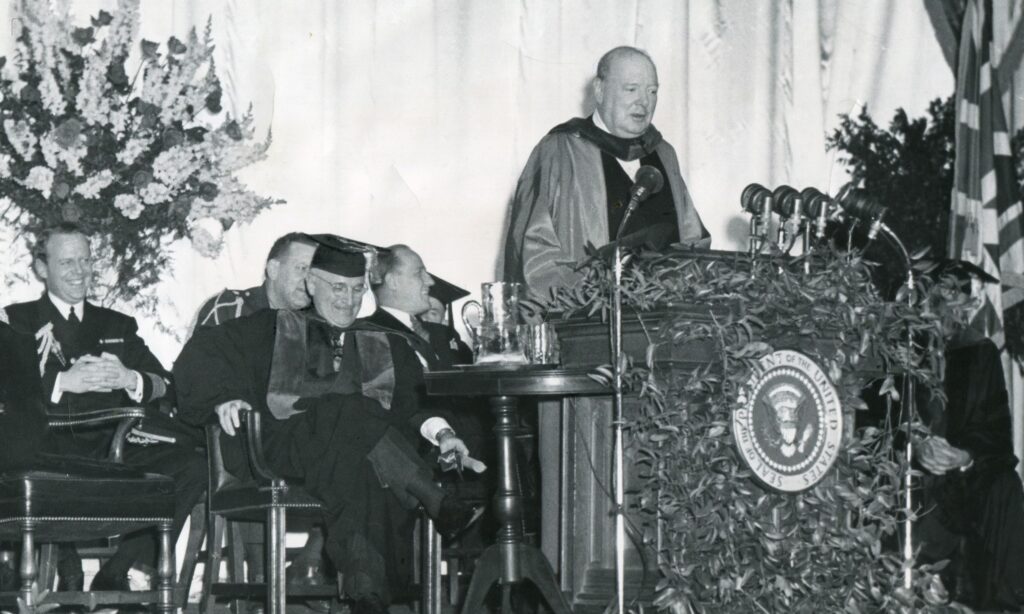
Winston Churchill delivers the lecture he called “The Sinews of Peace,” better remembered as the “Iron Curtain” speech, on March 5, 1946, in the gymnasium at Westminster College in Fulton (Photo courtesy of Westminster College).
FULTON — What is leadership?
That was the question Fulton Middle School eighth grader Kendall Acton posed Thursday to Winston Churchill — or at least to actor Randy Otto, who has spent more than 50 years portraying the former British prime minister on stage.
The answer, Otto told an audience of about 400 students, could be found in advice Churchill once gave a new member of Parliament preparing to make his first speech:
“Be clear. Be concise,” Otto said. “And then, for God’s sake, be seated.”
But more than that, Otto continued, “the first thing you must have is a vision of what you want to lead about and you must be able to then write it down.”
Acton said afterward that he thought he got good advice.
“It was very informative,” Acton said. “I enjoyed it.”
Otto was in Fulton for two performances. His presentation for students called “Defending Liberty” in the Westminster College’s Historic Gymnasium was part of the 80th anniversary commemoration of Churchill’s historic lecture remembered as the “Iron Curtain” speech.
Events began Thursday and continue into Saturday.

The lecture that became one of the most consequential speeches in world history took place on March 5, 1946. Churchill came to Fulton with President Harry Truman, the only native Missourian to serve in the White House.
The previous fall, Truman had urged Churchill, ousted as prime minister of Great Britain in an election soon after the end of World War II in Europe, to accept an invitation to speak at Westminster College.
“This is a wonderful school in my home state,” Truman wrote at the bottom of the invitation. “Hope you can do it. I’ll introduce you.”
In his speech, Churchill surveyed the wreckage of World War II, its impact on the lives of individuals and warned that the world was dividing again into opposing camps that carried the threat of another war.
“From Stettin in the Baltic, to Trieste in the Adriatic, an Iron Curtain has descended across the continent,” Churchill said. “Behind that line lie all the capitals of the ancient states of Central and Eastern Europe.”
They were occupied by troops of the Soviet Union following the defeat of Nazi Germany and, Churchill warned, “subject in one form or another, not only to Soviet influence but to a very high and, in many cases, increasing measure of control from Moscow.”
The speech was broadcast worldwide on radio decades before the term livestreaming entered the lexicon. It is often marked as one of the opening statements pronouncing a Cold War between the Soviet Union and its Western allies.
It made Westminster the home of America’s National Churchill Museum, which is sponsoring the commemoration, and,over time, it became a destination for world leaders delivering major speeches. Those who have spoken there include Gerald Ford, who spoke as president, and Ronald Reagan, who visited in 1996. There was also Mikhail Gorbachev, former president of the Soviet Union in 1992, Margaret Thatcher, former prime minister of Britain in 1996, and Lech Walesa, former president of Poland, in 1998.
The commemoration is intended to find relevance in Churchill’s speech for a modern audience, said Tim Riley, director of the Churchill Museum.
“With conflict in the Middle East, in Ukraine, it affords us a terrific opportunity to look at Churchill’s words afresh and anew and see if there are still lessons we can learn from his speech that he gave here 80 years ago,” Riley said in an interview with The Independent.
Duncan Sandys, a great-grandson of Churchill, will participate Saturday in a fireside chat during the induction of new members of a museum support group, the Association of Churchill Fellows.
“I’m, obviously, you know, deeply proud that he’s being remembered, and what he said is being remembered in this way,” Sandys said in an interview with The Independent. “But more importantly, I think that events like this wouldn’t take place unless what he had to say was still relevant for people today.”
Churchill’s life
The invitation to speak at Westminster College, from its president, Franc McCluer, caught Churchill at a time when he was idle after losing the 1945 election and contemplating a vacation. He decided on Florida for the vacation and accepted the invitation.
Born in 1874, Churchill had been a figure on the British political scene since the first years of the 20th century. He was a young officer moonlighting as a war correspondent when he was captured in 1899 during Boer War and won fame for a grueling 300-mile escape trek through enemy territory.
By the opening of World War I, Churchill was First Lord of the Admiralty, the civilian chief of the British Navy. He lost that post over public outcry over failed military operations attributed to his aggressiveness. But he is also remembered as the minister who fostered the invention of the tank, the weapon that finally broke the deadlock in France and led to the end of the war.
Churchill’s warnings about the dangerous rearmament of Germany under Nazi rule in the 1930s went largely ignored until the war in Europe began in September 1939. First recalled to the Admiralty, he became prime minister on May 10, 1940. That same day, the Nazis invaded the Netherlands, Luxembourg, Belgium and France.
In his performance Thursday, Otto used Churchill’s words in his first speech as prime minister to show the students that truth from leaders who trust, and in turn are trusted, by the people is a powerful tool for unification.
“I have nothing to offer but blood, toil, tears and sweat,” Churchill said May 13, 1940.
His policy, Churchill said that day, would be to “wage war, by sea, land and air, with all our might and with all the strength that God can give us; to wage war against a monstrous tyranny, never surpassed in the dark, lamentable catalogue of human crime.”
Churchill’s gift for vivid imagery made his speeches memorable and inspiring. He wrote dozens of books focused on history and his own life and work, made a living as a magazine feature writer in the 1930s while out of office and wrote all his own speeches.
During his response on leadership, Otto encouraged the students to write down what they believe and be brief.
“Being clear and concise is very important,” he said. “You must use small words.”
Less than two months after the German surrender, Churchill’s Conservative Party lost the 1945 election and he was no longer prime minister. He would return to office in 1951, serving as prime minister until his retirement in 1955.
Churchill died in 1965 at age 91.
The speech
Churchill’s visit was to formally give the 7th John Findley Green lecture, a series established to honor a Westminster alum and longtime trustee.
True to his word, Truman introduced Churchill. They had traveled together on a train from Washington, D.C.
“He is one of the great men of the age,” Truman said to the audience of about 2,700 packed into the auditorium. “He is a great Englishman. But he’s half American.”
Churchill’s mother was born in the United States.
“I know that he will have something constructive to say to the world in that speech,” Truman said.
And as he began, Churchill used humor to settle the audience.

“The name Westminster somehow or other seems familiar to me,” Churchill said as he feigned a poor memory. “I feel as if I had heard of it before.”
Westminster is where the British Parliament sits.
He then continued.
“It was at Westminster that I received a very large part of my education…in politics, dialectic, rhetoric, and one or two other things,” Churchill said.
The heart of Churchill’s message was that strategic alliances and international cooperation could break the cycle of war that had gripped the world in the first five decades of the 20th century.
The uncountable millions dead from the war — estimates range from 60 to 85 million military and civilian deaths — plus hundreds of millions homeless or near-starving, needed peace, Churchill said.
“When I stand here this quiet afternoon I shudder to visualise what is actually happening to millions now and what is going to happen in this period when famine stalks the earth,” Churchill said. “None can compute what has been called ‘the unestimated sum of human pain.’ Our supreme task and duty is to guard the homes of the common people from the horrors and miseries of another war.”
Churchill wanted the United Nations to be given a portion of each member power’s military force, to intervene and prevent wars and enforce international law. He did not, however, want to give up the secrets of the atomic bomb that had been produced cooperatively by the United States and Britain.
In the hands of a totalitarian state, “the fear of them alone might easily have been used to enforce totalitarian systems upon the free democratic world, with consequences appalling to human imagination,” Churchill said.
Legacy and celebration
The events at Westminster this week will be as lighthearted as local cooks competing for the best reproduction of the angel food cake served to Churchill and as serious as the speech Churchill himself gave.
To join a display of classic vehicles, Chris Kertz of Ste. Genevieve brought his M5A1 Stewart tank, and discussed the equipment, armor and soldier rations he displayed with visitors admiring the light tank.
He’s proud of his tank, which has a working 37-mm gun to fire blank charges, and wears the patch of the 10th Armored Division.
“I collect other military vehicles as well,” he said. “A tank is the ultimate collector’s item.”

Exhibits launched during the commemoration, including the speech pages showing Churchill’s final notes written in shorthand, will be on display at the museum into July, Riley said.
The museum, founded in 1969, is housed in the restored 17th-century church of St. Mary the Virgin, Aldermanbury created by British architect Sir Christopher Wren. It was bombed and badly damaged during World War II, and relocated from London.
The grounds of the museum also display Breakthrough, a sculpture made from a piece of the Berlin Wall — the physical embodiment of the Iron Curtain that surrounded the east portion of Berlin from 1961 to 1989.
It was created by artist Edwina Sandys, Churchill’s granddaughter and aunt of Duncan Sandys, who attended the 50th anniversary commemoration in 1996 and said the museum has grown and prospered over the past 30 years.
“That’s a testament not only to the to the leadership of Westminster College and and of the museum over the over those decades, but it wouldn’t have grown in the way that it has, if that interest in Churchill and in his values and in what he stood for didn’t resonate with people beyond a narrow section of the population,” Sandys said.
The museum would be designated a national historic landmark under a bill sponsored by U.S. Rep. Bob Onder of Lake St. Louis that passed Tuesday in the U.S. House.
The museum doesn’t overlook Churchill’s worldview or errors in judgment. He was an unapologetic imperialist and he opposed the abdication of King Edward VIII, who later showed a strong affection for Nazi ideas.
“It’s important to look at Churchill as a whole individual,” Riley said, “and recognize and remember that this was a man who was born in 1874, who was part of the last cavalry charge of the British Empire under Queen Victoria, and died in 1965, when the Beatles were on the charts.”
In his performance, Otto brings in modern ideas, as if Churchill had not died.
To illustrate the dangers of a government intent on destroying freedom, he incorporated quotes from 1984, George Orwell’s novel of a totalitarian society where history is erased and everyone lives under constant surveillance.
He used his final moments on stage as Churchill to warn students of a digital iron curtain, where information can be manipulated and falsified.
“Today, the advice I would give to anyone is to not utilize your phones,” Otto said. “Don’t utilize what is called today artificial intelligence. Stop using everyone else’s ideas. Find your own ideas and learn how to write them down.”