Plan to put Medicaid work requirements in Missouri Constitution advances

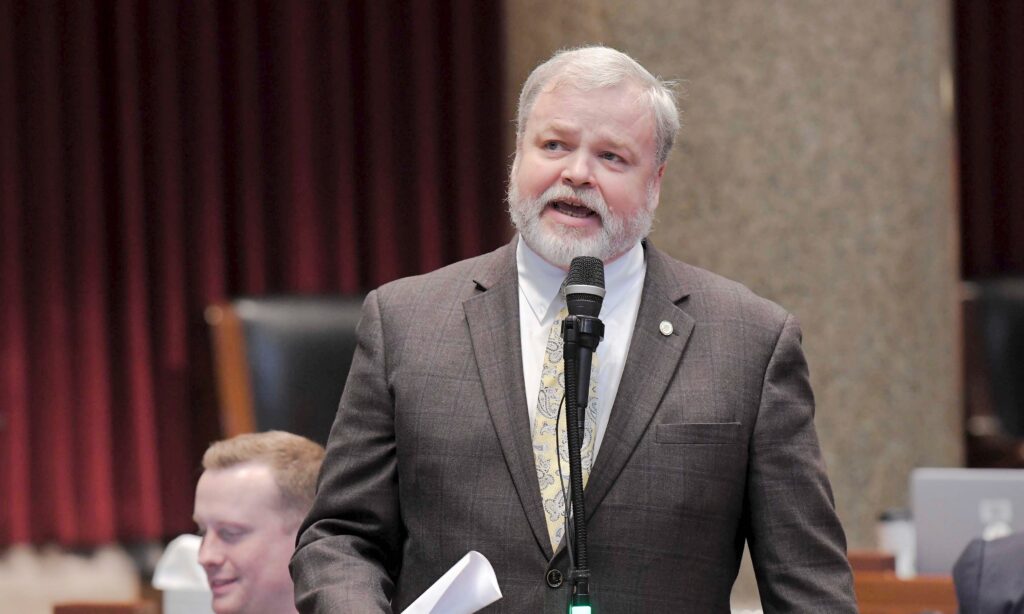
The proposal, sponsored by Republican state Rep. Darin Chappell of Rogersville, would make it harder for Missouri to reverse Medicaid work requirements if voters approve the constitutional amendment and if federal law changes. Chappell said his proposal is not intended to defund Medicaid expansion (Tim Bommel/Missouri House Communications).
Missouri Republicans voted Thursday to advance a plan to add Medicaid work requirements to the state Constitution, hoping to put the issue before voters in November.
Democrats insist the proposal, which passed the Missouri House 99-48 on a party-line vote, would open the door for state lawmakers to defund the voter-approved expansion of Missouri’s Medicaid program, MO HealthNet.
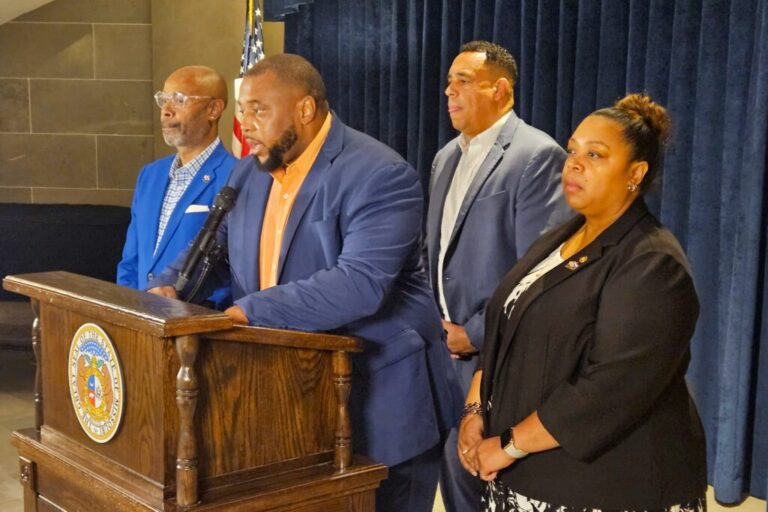
House Minority Leader Ashley Aune, a Democrat from Kansas City, told reporters that defunding Medicaid expansion is “the one reason that Republicans want to put this measure in front of Missouri voters.”
Republican state Rep. Darin Chappell of Rogersville, the proposal’s sponsor, told The Independent that this is not the intent of the bill.
“The only individuals that would be unfunded are able-bodied adults [ages] 19 to 64, physically capable of working, and they’re unwilling to work half-time, go to school half-time, [participate in] a work program [or] do community service for 80 hours a month,” Chappell said.
Chappell said his proposal is “intended to mirror” Medicaid work requirements passed by Congress in July 2025 as part of the One Big Beautiful Bill Act. Even though defunding expansion is not his intent, he said he can’t predict how a court might rule should the issue come up in the future.
“I quit guessing how the courts will interpret something a long time ago,” he told The Independent. “I can only speak to my intentions.”
Starting next year, federal law will require states to verify that people who would otherwise qualify for Medicaid as part of the adult expansion group worked, volunteered or studied for 80 hours during the previous month in order to enroll. States will also have to recertify individuals’ eligibility twice yearly rather than annually.
The federal provisions will override current language on Medicaid in the Missouri Constitution starting next year even if Chappell’s measure fails because the U.S. Constitution declares laws passed by Congress the “supreme law of the land.”
But Chappell said during debate on his proposal last week that he wants Medicaid work requirements in Missouri to outlast any future changes to federal law.
“Someday that law may be changed,” Chappell said, “and I believe that this is good policy, and it needs to be on a permanent level within the state.”
Legal questions
Aune told reporters that Republicans are trying to trick Missourians who support work requirements into voting to allow state lawmakers to defund Medicaid expansion.
“They know, because the courts told them explicitly, that they cannot do it statutorily, so they have to do it constitutionally,” Aune said. “They are taking it to the voters, but they’re putting ballot candy on there to make Missourians think that they’re voting on work requirements, which the federal government has already told us we have to impose.”
Chappell told The Independent that his proposal does not contain “ballot candy.”
“This is a functional application of common sense to a situation that has diminishing funds available for people in desperate need,” he said.
The ballot measure, if approved by Missouri voters, would strike from the state Constitution a prohibition on imposing “greater or additional burdens or restrictions” on people who qualify for Medicaid as part of the adult expansion population.
Missourians voted in August 2020 to expand Medicaid eligibility to include adults aged 19 to 64 with household incomes of 138% or less of the federal poverty guideline. In 2026, that’s $45,540 a year for a family of four.

State lawmakers in 2021 blocked former Gov. Mike Parson’s plan to fund Medicaid expansion in accordance with the voter-approved amendment. The Missouri Supreme Court overturned a trial court ruling affirming lawmakers’ decision, and MO HealthNet began accepting applications for expansion coverage in August 2021.
The state Supreme Court referred to the section of the constitution that Chappell’s proposal would delete when it ordered Missouri to expand Medicaid.
“With no ambiguity, the amounts appropriated and other extrinsic evidence cannot be used to alter the plain language of the purposes stated – to fund MO HealthNet without distinguishing between benefits provided to individuals who are eligible as part of the pre-expansion and those eligible only under” the amendment, the court wrote.
The proposal also removes a provision requiring the state to seek maximum federal financial participation to fund Medicaid expansion.
State Rep. Betsy Fogle of Springfield, ranking Democrat on the House Budget Committee, told The Independent that removing the two provisions endangers Medicaid expansion.
“I think very easily and clearly you could point to, that’s an attempt to defund expansion,” Fogle said.
High stakes
Chappell, who is chair of the House budget subcommittee covering social services, said potential savings from his proposal could help the state afford services for vulnerable Missourians. He referred to dozens of Missourians who crowded into a Capitol hearing room last week to oppose Gov. Mike Kehoe’s proposed $80.7 million in cuts to programs that help people with developmental disabilities live safely in their homes.
“I will not let $1 be wasted on someone who’s capable and will not work, [and] be taken from those folks,” Chappell told The Independent. “…Every dollar we spend is $1 that’s no longer available.”
Republican state Rep. Renee Reuter of Imperial underlined the potential for work or volunteering to enrich people’s lives.
“It’s important for our people to be encouraged to work, to be encouraged to find their purpose,” she said.
But Democrats said that layering state work requirements over the federal changes would cost the state money and hinder the ability of the Department of Social Services, which administers Medicaid enrollment and eligibility, to meet a series of rapidly approaching federal benchmarks.
The fiscal note for Chappell’s proposal indicates a cost of $9 million to put the issue on the ballot in November.
Social Services Director Jess Bax told lawmakers in January that if the department does not decrease its Medicaid error rates below 3% by October 2029 — while implementing the new changes — the state could face a clawback of up to $1.2 billion in federal funding. She said the state’s error rate in 2019, the year of the last federal audit before the COVID-19 pandemic, was 35%.
Democratic state Rep. Melissa Douglas of Kansas City said the proposal would make the department’s job harder.
“We stand here to remove barriers,” she said.
Democratic state Rep. Aaron Crossley of Independence said the state should spend money directly on services that help Missourians.
“We should support policies that are going to get money to the people that need it most,” Crossley said, “and not to bureaucrats sitting in offices making monthly determinations on people’s eligibility.”