Black History Month shines light on institutionalized racism in our educational system

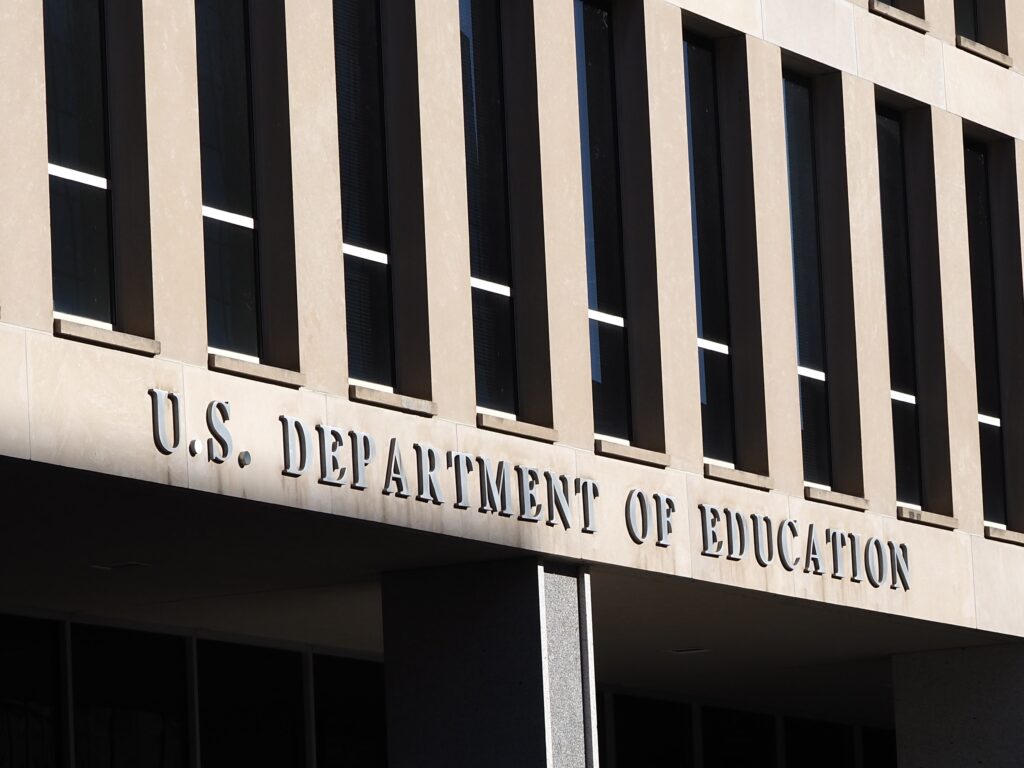
The Lyndon Baines Johnson Department of Education Building pictured on Nov. 25, 2024 (Shauneen Miranda/States Newsroom).
Using snapshots of the history of Blacks as a corrective and curative measure for one month is tantamount to applying a band-aid to treat a virulent and stubborn disease.
Except for providing a minimal degree of comfort for Black Americans, what lasting meaning does it have for the rest of America?
There is a better idea whose acceptance is long past due.
In addition of trying to make up for the omissions of the experiences and contributions of Blacks in history books, focus on and correct the many other disparities that are caused and perpetuated by institutionalized and systemic racism in education. That would be much more valuable and have long-lasting impact.
Institutionalized racism is so prevalent and entrenched — even taken for granted — in our schools, from kindergarten to college.
At the primary and secondary level, institutionalized racism is evident in many ways: how resources are allocated; how students are assigned to learning tracks and teachers; and how we continually push a curriculum with a scarcity, or even worse, almost the complete absence of Black authors, inventors, scientists and the many other contributors to American history.
That is, until Black History Month rolls around where we select a few highlights here and there.
Let’s focus on one in particular.
No doubt during this month, the victory of Brown vs. Board of Education — the U.S. Supreme Court case that was supposed to end segregated schools and provide a pathway for Black children and other minorities to have equal access to a quality education — is being heralded.
In 1954, Blacks thought they had won the opportunity to receive a quality education. In 2026, more than 70 years later, not a whole lot has changed.
Schools are still very segregated. Too many Blacks and other minorities are not graduating — and are not leaving with a quality education when they do.
The looming question: At what point will America stop the charade and get serious about addressing in a broad and meaningful way the institutionalized racism that pervades public education?
We see the negative results at the personal and societal level, year after year, decade after decade, generation after generation.
Evidence abounds about how a poor-quality education impairs one’s ability to understand oneself, others, one’s environment in terms of culture, history, social mores and expectations.
Poor quality education impairs and limits one’s ability to make decent wages. Limited earning power directly impacts buying power. When buying power is hampered, it breeds and fosters other things: hopelessness, despair, and often resignation to a poorer quality of life. It also, too often, results in a life of crime.
A poor education breeds these vicious cycles that impact generation after generation.
They exist blatantly within our view. We see the impact of an educational system that is failing our children every day when we drive around the neighborhoods and see lost faces, wandering souls on street corners, in alleyways, at store fronts.
Yes, parents, neighbors, churches and other community organizations play a role in keeping kids in school. But fundamentally, what is happening to the child once he or she is inside the school building, the classroom?
We all know of children who come from dysfunctional families, so-called “bad-neighborhood” and simply oppressive environments, who find refuge and hope in the school and go on to apply themselves, become productive citizens, often achieve greatness and go on to break the cycle of poor education in their family.
This scenario may be the exception. But it can be the rule. It can happen more often than not if teachers and administrators are equipped and encouraged to do the job they are hired to do.
Beyond the personal devastation a poor-quality education causes, it also wreaks havoc on a community in many other ways.
There are many areas in our public education system that need redress and meaningful change.
It is a common phenomenon that a school system with a reputation of poor educational achievement causes urban flight. People abandon the city and head for the suburbs.
New people coming into a new city will buy or not buy a home based on the reputation of the public schools.
Some businesses choose to move or expand their operations in a neighboring suburb to accommodate their likely employees — all because of the image and impact of a poor- quality school system.
The impact on the economy does not stop there.
Poor educational systems are impacting urban cities across America.
Why isn’t a quality education for Blacks and other minorities — who are primarily urban dwellers — higher on the list of our national priorities seventy years later as we continue to witness the detrimental and destructive impact?
Is it because entrenched and inherent racism and all the enduring stereotypes, biases and prejudices keep decisions and policies that would improve most communities and peoples’ lives from being adopted and implemented?
That certainly appears to be the case.
Look at the conversations and policies governing your state legislature and the halls of Congress when it comes to ensuring that all of our children have an opportunity to get a quality education.
What do you see?
More importantly, are their educational priorities and allocation of funds in the best interests of families and their children as they work to have the best life they can?
Black History Month can only function as a temporary placebo to acknowledge past Black achievements.
Focusing on and addressing real educational disparities to bring about meaningful change is what is needed.
Beyond Black History Month.