Missouri House shows support for bill aimed at antisemitism

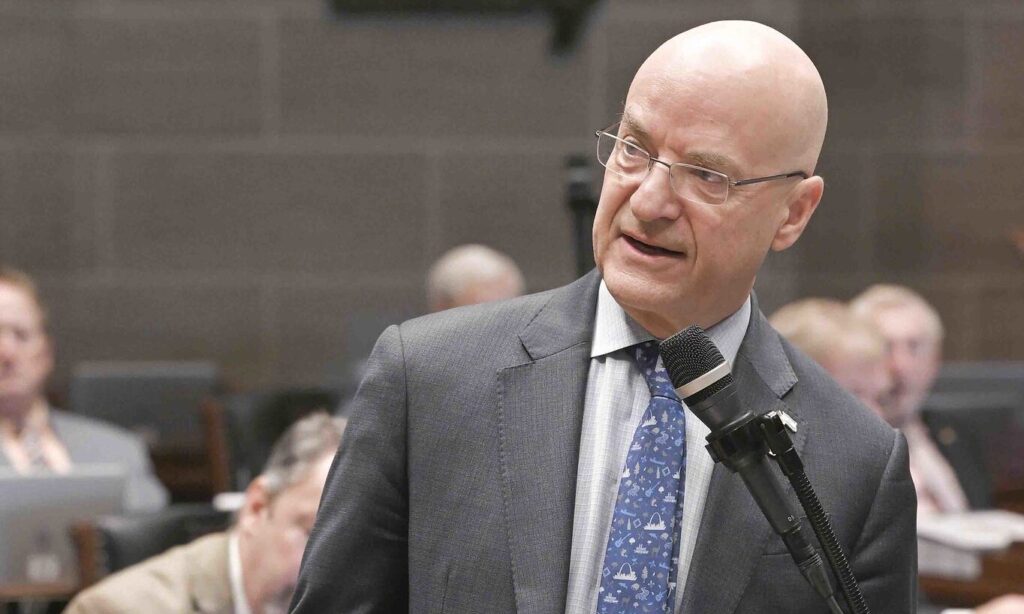
State Rep. George Hruza speaks, a Republican from Huntleigh, speaks during House debate in 2025 (Tim Bommel/House Communications).
A bill that aims to prohibit antisemitism within public schools and institutions of higher education won initial approval this week in the Missouri House.
State Rep. George Hruza, a Republican from Huntleigh and the descendant of a Holocaust survivor, said sponsored the legislation because he feared for the safety of Jewish students in the years since the Oct. 7, 2023, attacks on Israel.
“That Missouri Jewish students are blamed for what is happening in Israel and Gaza is absurd,” Hruza said. “They have absolutely no input or control over what is happening there.”
He claims that the attack and subsequent war have sparked an uptick in antisemitic acts across the country.
“Within hours,” Hruza claimed, “Antisemitic protests against jews and acts of violence against jews erupted and escalated. Especially on college campuses.”
The bill establishes a standard definition for antisemitism to be used by educators to decide what qualifies. Any incident in violation of that definition must be reported under Title VI, a component of the 1964 Civil Rights Act. This would allow researchers to track the trends of antisemitism inside Missouri’s school systems.
The bill won initial approval this week despite strong opposition from Democrats who fear it will prevent open discussion in schools, and concerns that it disregards other forms of hate speech.
“As a teacher, I am deeply concerned with this bill,” said state Rep. Elizabeth Fuchs, a St. Louis Democrat. “What we are discussing is a way to silence the voice of teachers, using being labeled as an antisemite as a vehicle.”
She went on to say that the bill would prevent educators from bringing up current events, like Israel or Palestine, out of fear of being labeled antisemitic.
Fuchs said that she was a professor during the Oct. 7 attacks and had both Israeli and Palestinian students.
“My job as an educator was to find a path to talk about it,” she said. “To bring both of the communities together to a table to have a conversation. This bill … would create a pause for professors and teachers.”
State Rep. Bridget Walsh Moore, a Democrat from St. Louis, claimed that the passing of the bill would result in antisemitic incidents being treated with more severity than other kinds of discrimination.
“You see how it’s creating a hierarchy? How some things are worse than others?” asked Moore. “Because this is going to be reported to the state, but if you’re called the N-word and someone pulls your braids, well, that’s gonna be an in-school suspension.”
The House adopted a proposed amendment by state Rep. Bill Hardwick, a Republican from Dixon, that would prevent any instances of religious or political speech protected under the First Amendment from being reported, compiled or published.
After questioning from state Rep. Mark Boyko, a Democrat from Kirkwood, Hardwick confirmed that the potentially controversial acts of burning an Israeli flag or wearing an arm band in support of Palestine would not be considered antisemitic under this definition.
A similar bill passed the House last year, but never made it to the full Senate for a vote. The legislation will need to be voted on once more by the House before being sent on to the Senate again this year.
This story originally appeared in the Columbia Missourian. It can be republished in print or online.