Redlining and its modern impact on St. Louis

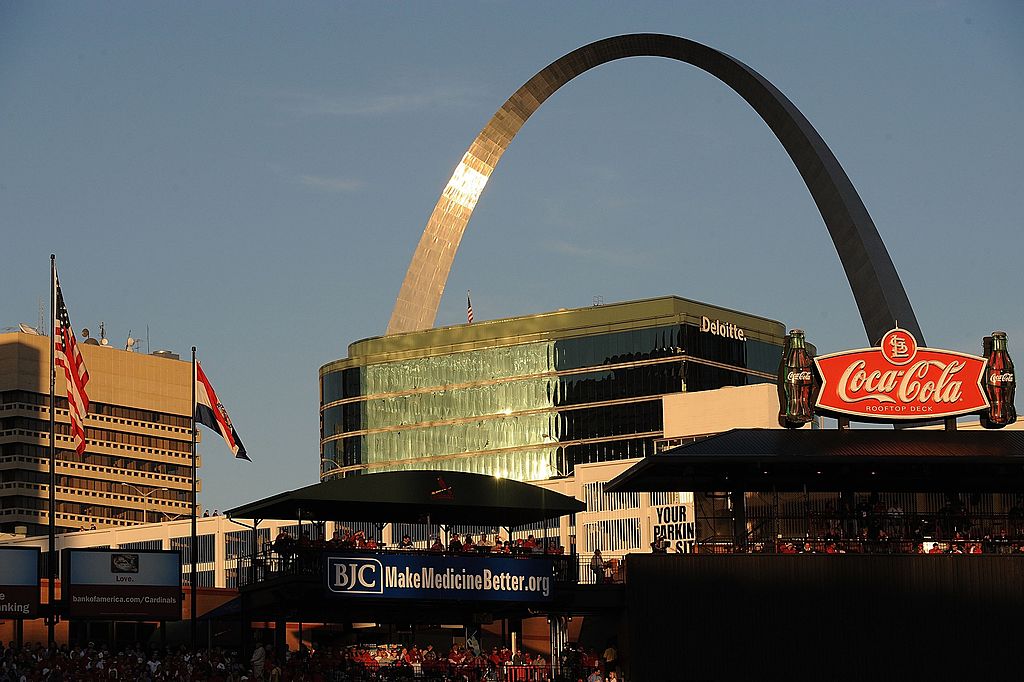
The St. Louis Gateway Arch on Oct. 10, 2009 (Ronald Martinez/Getty Images).
“The Negro should be granted equality…On the surface, this appears reasonable, but it is not realistic. For it is obvious that if a man is entered at the starting line in a race three hundred years after another man, the first would have to perform some impossible feat to catch up with his fellow runner.”
As evidenced by the above quote, Dr. Martin Luther King contends that equality implies equity. Equity is fairness or justice in how people are treated and is meeting people where they are and providing help and support to strengthen their quality of life.
While Black American rights are constitutionally enshrined daily, they are obstructed and as King says, force Blacks to attempt the impossible–catch up. African Americans live in a society that holds them back to just after the starting line thereby preserving socioeconomic inequality.
The Homeowner’s Loan Corporation in 1935 developed and became the primary organization that enforced real estate segregation through redlining. To push segregation, local St. Louis newspapers and television broadcasts aided redlining by publishing maps to identify parts of the city that were “desirable” or vibrant to attract new, white buyers into nicer neighborhoods.
Prospective Black homeowners were pushed into “dangerous” or declining neighborhoods. Decades-long racist redlining triggered lasting, devastating socioeconomic impacts limiting Black American access to critical healthcare,financial services, and educational institutions. As time progressed and while redlining was officially revoked, racial stigmas surrounding establishing businesses in black neighborhoods persisted.
Specifically, an Economic Innovation Group case study validates this idea. This study found that in North St. Louis, the historically Black American areas have a 32% poverty rate and a 41.7% vacancy rate. Moreover, 18.6% of the residents do not hold a high school diploma, likely resulting in 33.3% unemployment. The EIG further finds that areas with 73.7% white population had a 10.7% poverty rate, an 11.5% vacancy rate, 7.3% of residents did not have a high school diploma, and an unemployment rate of 18.1%.
Negative poverty, vacancy and unemployment rates are almost double or triple for African Americans.
Access to quality education further exacerbated Black American pursuit of equity in St. Louis. A 2025 St. Louis Public Radio report found that 27 out of 42 elementary schools, 5 out of 11 middle schools, and 5 of 10 high schools were closed or are slated to close due to lack of funding, poor standardized testing, and a decreasing population in the school districts due to poor education.
Redlining also limited the availability of necessary services in predominantly Black neighborhoods. Medical services, arguably the most essential of all services are seemingly absent in most of northern St. Louis. Limited healthcare resources in predominantly black neighborhoods prevented proper care for chronic illnesses and lowered life expectancy rates.
In a 2021 study, Washington University and St. Louis Louis University finds an exacerbated amount of hospitalization rates due to chronic diseases in St. Louis based on race. They found with heart disease, 20,800 Black Americans compared to 10,200 whites were hospitalized. Regarding cancer, 44,000 African Americans compared to 33,000 white Americans were hospitalized.
Regarding strokes, 50,000 African Americans compared to 28,000 whites were hospitalized. These statistics demonstrate that African Americans are more impacted by chronic illnesses than white people, due likely in part to a lack of access to and the ability to pay for critical healthcare prevention and treatment resources.
The devastating early 20th century redlining policy successfully obstructed Black community and individual development and success and stunted the realization of African Americans equality — guaranteed by our founding documents and Civil Rights Acts.
Redlining outcomes like an underfunded education system; poor access to healthcare, gentrification continues to have disastrous impacts on Black American individuals and their communities. Initiatives and social innovation groups like the Delmar Divine (health care and educational aid), Beyond Housing Programs (helps the displaced) and Guardian Angel Settlement Association (aid to families and children), do not fully offset redlining policy legacies.
What will help push for legislation to aid these communities is a gathered consensus amongst the people of St. Louis to bring change. There are people ranging from a block away to thirty minutes away that are not aware of the history of St. Louis and how redlining has affected the minority population.
It’s important to have people from near and far to become aware of these inequalities that are becoming exacerbated as the years go on to gain awareness. More funding to provide adequate housing for those displaced by gentrified areas would help. Community work done through social work, political activism, and monetary donations is critical. These groups need to be careful to avoid savior approaches or pre-determining community needs.
Finally, to ensure critical and sustainable change, St. Louisans must be better informed about disparities and inequities facing Black individuals in these areas. Local politicians and media need to increase awareness of these problems. Only by acknowledging and addressing the legacy of redlining and its offshoot inequitable impacts can we make St. Louis a more equitable place to live.