Cancel a speech, but not the Missouri Constitution

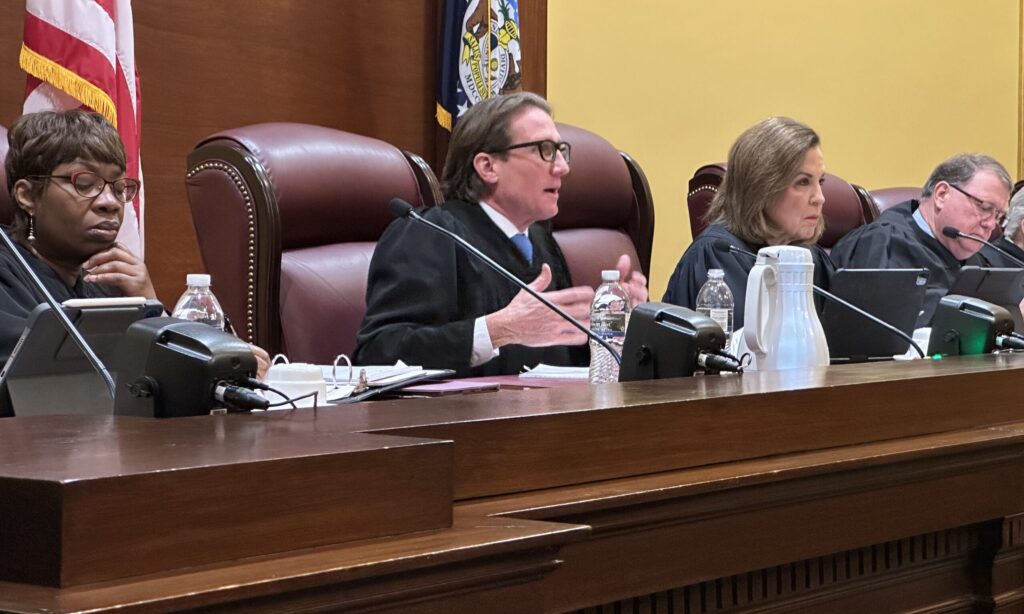
Missouri Supreme Court Judge W. Brent Powell, second from left, questions attorneys during arguments in February 2024 in a case challenging the Missouri Senate district map. The other members of the court shown are, from left, Judge Robin Ransom, Chief Justice Mary Russell and Judge Zel Fischer (Pool photo by David Lieb/Associated Press).
The Jefferson City drama this week was the cancellation of the Missouri chief justice’s annual “state of the judiciary” speech to a joint session of the legislature, a cancellation in response to a unanimous state Supreme Court decision that enforced the constitution’s rule that a bill must have only one subject.
The objection from some legislators — who kept the legislature from having its joint session — was not that the unanimous court was wrong on the law, but that the court had the audacity to enforce the constitution and strike down a law that violated the constitution.
This Missouri Constitution’s requirement does not exist in the United States Constitution, which puts no limits on how many unrelated subjects can be jammed into one big bill, beautiful or not. Missouri legislators often are tempted to mimic their federal counterparts by passing “omnibus” bills that gather support by using a bill as a “Christmas tree” on which to hang various legislative ornaments to attract votes sufficient to achieve a majority needed to pass.
That can mean that a legislator must decide whether to vote for a bill whose provisions a legislator disagrees with in order to get a provision he or she wants.
The Missouri Constitution since 1875 has included the requirement, which today is expressed very simply: “No bill shall contain more than one subject which shall be clearly expressed in its title.” Other provisions enforce this basic requirement.
I have noticed over decades of observing the politics of judicial selection that the legislators who pitch fits about the nonpartisan court plan — added by voters in 1940 to the Missouri Constitution — do not seem to represent the views of a majority of Missourians.
In 2012, the legislature proposed a ballot measure to give the governor the majority of appointments to the appellate judicial commission and to allow the governor to appoint lawyers as well as nonlawyers to the commission.
It was a bad idea, the result of Jefferson City people not being able to distinguish the views of the people who hang out in the Capitol and people who live their lives outside the greater Jefferson City area. The voters agreed. They said no.
The nonpartisan court plan gives the governor the power to name three non-lawyers to the appellate judicial commission, and gives the members of the Bar in the three court of appeals districts of the state the vote to name one lawyer from each district.
The chief justice, the judge who serves a two-year term in rotation as chief, is the seventh member of the commission. When a vacancy occurs in an appeals court or the supreme court, the commission evaluates nominees and sends the names of three nominees to the governor, who must select from the list. If the governor does not appoint from the list, the commission will do so.
A judge must face a retention vote after serving on the bench for a year, and at the end of each term (12 years for a supreme court judge), and must retire at age 70.
Since its adoption by the voters in 1940, Missourians have voted for measures that strengthened the plan. By contrast, voters said no to a measure referred by the General Assembly in 1942 to end the plan and return to having all judges be elected. That lesson was not lost on the Constitutional Convention of 1944, which included the nonpartisan court plan in the state’s most recent Constitution that was adopted by the voters in 1945.
Since its adoption by Missouri’s voters in 1940, 38 states have adopted some form or variant of the Missouri plan for some or all judicial vacancies. Voters in those states, like Missourians, have recognized that it is not possible to eliminate all forms of politicking from judicial selection, but merit-based solutions can help minimize the influence of partisan politics.
The most sensible reaction this week to the Supreme Court’s decision enforcing the single-subject rule is the suggestion by some legislators that they should obey the constitution when doing their work.
Another suggestion: If legislators want to pass big bills, beautiful or not, they could ask the voters to change the constitution to make their work more like the work of legislators in Washington, D.C.
Good luck with that.