Cost of future Missouri school funding formula unclear as task force continues work

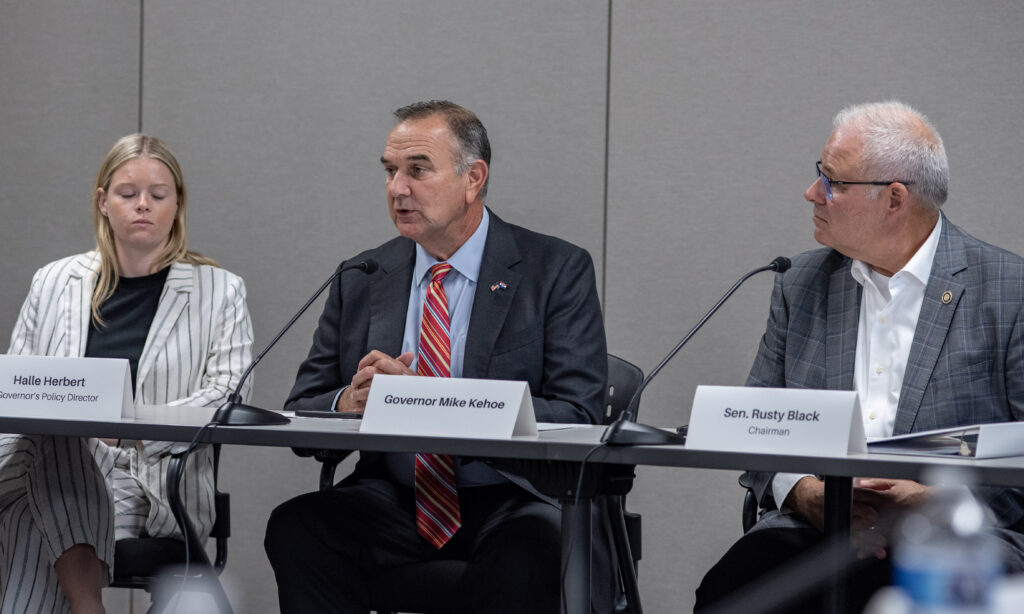
Missouri Gov. Mike Kehoe speaks briefly at a Sept. 9 meeting of the Missouri School Funding Modernization Task Force in the Missouri Special Olympics office building in Jefferson City. The task force met via video conference Monday for its first meeting since breaking into working groups (Annelise Hanshaw/Missouri Independent).
Missouri’s method for determining state aid for public schools is poised for substantial change, as a task force drafting the new funding formula began on Monday to synthesize four months of meetings into recommendations.
The group, dubbed the Missouri School Modernization Task Force, met Monday morning for the first time since breaking into smaller cohorts and looked at proposed changes to three parts of the formula.
Without the final components identified, it remains unclear how much the changes may cost.
Gov. Mike Kehoe’s budget proposal for the next fiscal year keeps the formula’s funding flat, declining to include a $190.6 million increase triggered by recent changes to state law.
With current budget discussions centering cuts, and Kehoe’s executive order telling the task force to reduce the formula’s bottom line, its members are keeping close watch on the numbers.
“We really have to be cognizant of the budget times we are in,” said task force member Don Thalhuber, the policy director for Missouri Senate Democrats who helped draft the current formula in 2005. “If the General Assembly can’t fund a $190 million increase… that is a problem that we are going to have to really think about as we craft this.”
The group’s plan follows the current formula’s broad structure, containing three multipliers and a reduction to account for funding districts receive from local property taxes.
One of these factors, called the state adequacy target, would increase from $7,145 to $11,504 under changes the task force is considering.
The number itself is just a starting point, with other factors and adjustments impacting the bottom line. The task force’s members did not dwell on the price tag, instead questioning the target’s stability.
The state adequacy target is intended to represent the per-pupil cost of an adequate education and is calculated by looking at how much high-performing school districts are spending per student. These districts are those who score 90% or higher on their annual performance reports.
Prior to 2022, a majority of school districts hit the high-performing mark. But since the state switched to a scoring system education officials deemed “more rigorous,” just 22 districts and one charter school have a three-year composite score above 90%.
The average expenditures of these districts were much higher, driving the formula up $300 million this fiscal year after years of stagnation. Between 2009 and 2024, the state adequacy target grew just 4% while inflation topped 33%.
Seeking to protect the target from large jumps in the future, the task force is proposing to look at the expenditures of the 100 top-scoring school districts.
Kari Monsees, who recently retired as the state education department’s finance chief, told the task force the switch would remove “variability,” though his calculations showed the number was not immune to outside forces.
Applying the group’s recommendations to previous years, there was a 10% jump in the state adequacy target between 2024 and 2025.
Monsees said this is because of “a lot of contributing factors.” He pointed to a push to raise teacher salaries as part of a workforce shortage.
“There are a lot of challenges there,” he said. “But seeing the increase from one calculation to the next has got me thinking that we may have to consider caps or something else within that calculation methodology.”
The group’s proposal more intentionally captures the cost of educating students from low-income families, those requiring accommodations for disabilities and English-language learners by factoring them into this part of the equation.
“It gets more down to the student level in terms of the demographics of a district and the students that they are serving,” Monsees said.
Factoring in the number of students in high-needs groups as part of the state adequacy target allows a shift in the way the formula gives extra funding for these students.
The current formula has thresholds, so only districts with a higher proportion of students in these categories get extra funding. The group wants to eliminate these cutoffs.
In total, this move would count an additional 8,000 low-income students, 35,000 students with disabilities and 2,400 English learners whose districts don’t receive extra funding under the threshold model.
Other changes discussed Monday include a switch to counting students based on enrollment rather than attendance, which was an early goal of the task force despite some members worrying it might have a negative effect on attendance.
The group is scheduled to meet next on Feb. 23 in Jefferson City. The group has until Dec. 1 to craft its recommendations and present them to the governor.