Pregnancy is being criminalized nationwide. Missouri must defend its constitutional protections

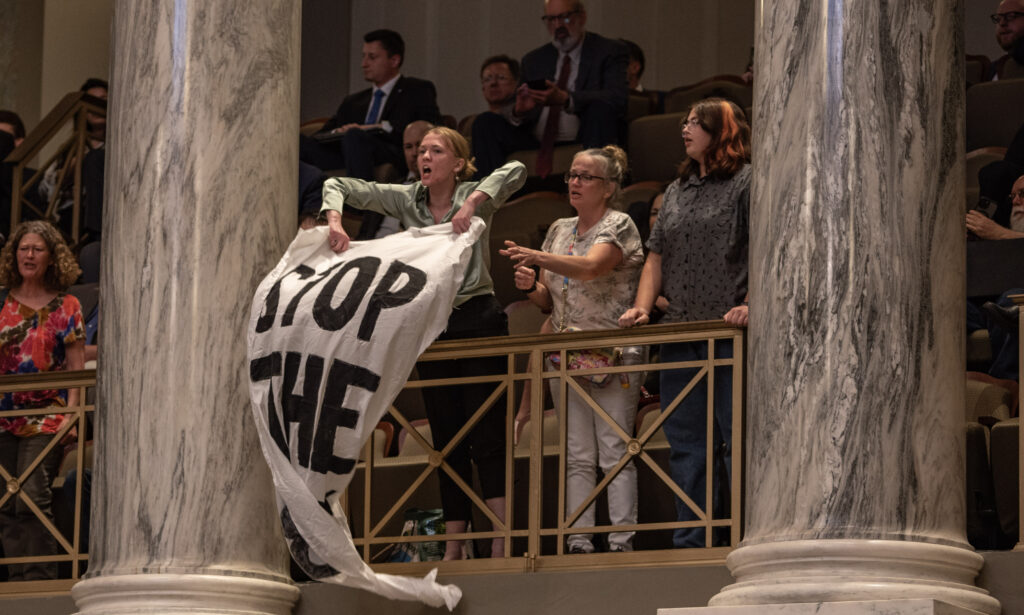
Jaeda Roth and other protestors from Abortion Action Missouri unfurl “Stop the Ban” banners as the Missouri Senate passes a proposed constitutional amendment to ban abortion (Annelise Hanshaw/Missouri Independent).
Since the fall of Roe, hundreds of individuals have been investigated, charged or prosecuted for their pregnancy outcomes across the nation.
Women denied miscarriage treatment have been investigated or charged for how they disposed of fetal remains. Hundreds have been charged for using illegal, legal, and prescribed substances while pregnant, even when their babies were born healthy or their miscarriages or stillbirths were likely caused by other conditions, like infections. Women have been charged for self-managing their abortions, even where laws ostensibly exempt them from prosecution.
Thankfully, we haven’t seen this in Missouri. So far.
A report released last year by Pregnancy Justice that catalogs these cases in the period from the Dobbs decision in June 2022 to June 2024 doesn’t include any in Missouri. Pregnancy Justice’s Dana Sussman cautioned me that this doesn’t mean it didn’t happen, and noted that we do have a pre-Dobbs history of arrests of pregnant and postpartum women, including ten cases in their 2023 report covering January 2006 to June 2022.
It’s good news that we haven’t seen the kinds of post-Dobbs cases that other states have. Unfortunately, I expect that is largely because our succession of anti-abortion attorneys general, and local prosecutors who share their goals, have been deterred by the Reproductive Freedom Initiative being on the ballot in 2024, and subsequently becoming law.
I suspect prosecutors didn’t want to raise the salience of what it meant for abortion to be a crime in Missouri before we voted on the initiative to enshrine reproductive freedom in our constitution (I’ll call that “Original Amendment 3”). Now that Missouri’s constitution protects individuals from prosecution for the alleged or actual outcomes of their pregnancies, prosecutors should see such cases as destined to fail.
Still, many of the cases Pregnancy Justice has documented involve situations where the law didn’t justify the charges, but prosecutors brought them anyway. Missouri’s anti-abortion prosecutors, however, can’t risk the bad publicity that could come from going after a woman blamed for her miscarriage or alleged to have self-managed her abortion because it could jeopardize our Republican legislators’ effort to repeal Original Amendment 3 via their New Amendment 3, which will recriminalize abortion unless voters vote it down this year.
The protection we have from criminalization under our hard won current law is vital to the health and liberty of Missourians, but it has been dismissed by anti-abortion leaders who refuse to acknowledge the documented harm to patients that Missouri’s criminal ban caused. Even a handful of abortion rights advocates who opposed the strategy of re-establishing abortion access via the ballot have ignored the importance of these new protections.
As numerous articles have documented, broad access to abortion has not been restored in the year since the passage of Original Amendment 3. Many of these articles frame this as a surprise and a disappointment.
It may be disappointing, but it is by no means a surprise. Advocates were not operating under the illusion that abortion care would be widely available the day after the vote. We anticipated a long slog.
First, you have to sue the state to have “Targeted Regulation of Abortion Providers,” a.k.a. “TRAP laws,” struck down. TRAP laws are medically inappropriate regulations disguised as health protections that have been enacted by anti-abortion officials in order to make it impossible for abortion clinics to function. Missouri’s TRAP laws are the reason abortion care was nearly eliminated in Missouri prior to the overturning of Roe.
Why a particular TRAP law is medically inappropriate can be pretty technical, and not at all obvious to the average person — or judge. In their lawsuit seeking to invalidate the many TRAP laws on the books in our state, Missouri’s ACLU and Planned Parenthood affiliates succeeded in convincing the court to preliminarily enjoin (that is, pause) a number of regulations while the litigation proceeds, allowing some abortion care to resume.
But the court declined to enjoin other TRAP laws that continue to make it impossible to expand access, especially to medication abortion. With the benefit of a trial beginning today that will include expert testimony, the court should enjoin the remaining regulations because the Missouri constitution now imposes a “super-strict scrutiny” standard that puts the burden on the state to prove that a regulation actually has a health benefit and is consistent with clinical standards.
If the trial court gets it right, it still won’t be over because the state will likely appeal.
Second, once a state’s abortion care infrastructure has been decimated, a legal win can’t restore it overnight. Clinics close and medical professionals leave. Even with a perfect ruling from the Missouri Supreme Court, rebuilding will take not only time and money, but providers who are willing to endure ongoing attacks from our anti-abortion supermajority in the legislature and other state officials.
Like I said, it’s gonna be a slog, during which many Missourians will have to continue to rely on out-of-state providers. That’s no reason not to fight the fight. Nor to dismiss how essential the protections that are in place today thanks to Original Amendment 3 are, which New Amendment 3 would eliminate.
Legal abortion does not equal accessible abortion. But legality has already made Missouri significantly less dangerous, even while abortion access remains limited. This is for two reasons: (1) hospitals are significantly less likely to deny or delay care for patients experiencing miscarriages due to the amendment’s protections against prosecution of medical professionals, and (2) Missourians are protected from criminal penalties for having abortions via telemedicine or self-management, and for experiencing miscarriages or stillbirths.
As to miscarriage treatment, I can’t promise you that every hospital has stopped delaying care or sending patients out of state and putting patients at risk of sepsis, loss of future fertility or death. Hospitals don’t typically make their legal guidance to medical providers public. But any decent hospital attorney should be advising that the Missouri Constitution now essentially eliminates the risk of prosecution for providing miscarriage care and provides a seemingly airtight defense in the unlikely case of a prosecutor going rogue and bringing charges anyway.
I am aware of hospitals and medical practices who have indeed updated their guidance.
As to the threat of criminalization of Missourians who self-induce their abortions or have adverse pregnancy outcomes, I cannot overstate how important the protections are that we established with Original Amendment 3 and stand to lose with New Amendment 3.
The vast majority of abortions occurring in Missouri today are either via telemedicine, that is, medical providers providing remote care from states with shield laws through organizations like Aid Access; or via self-management, in which individuals procure abortion medication without the assistance of a medical provider.
Before Original Amendment 3, telemedicine or self-management were legally risky, exposing abortion-seekers to law enforcement involvement or threats of it from abusive partners, family members or hospital staff.
Many in the anti-abortion movement deny any desire to see women prosecuted for having abortions. Missouri’s now invalidated ban exempted “a woman upon whom an abortion is performed” from prosecution for a “conspiracy” to violate the ban. But that left room to charge someone who was not part of a “conspiracy” because she self-induced.
The threat is real. Women are being prosecuted across the country. Missouri has long been at the forefront of anti-abortion legislation. We have a fetal personhood law on the books that was upheld in 1989 by a less fanatically anti-abortion U.S Supreme Court than we have today. State Sen. Mike Moon has once again introduced a bill that would subject women who have abortions to homicide charges.
Missouri’s attorney general has concurrent jurisdiction over abortion prosecutions, which means that if your local prosecutor has no interest in prosecuting abortion seekers, the attorney general can.
Our new attorney general, Catherine Hanaway, recently demonstrated her enthusiasm for harsh criminal penalties for abortion by citing the Comstock Act multiple times in a recent court filing. The Comstock Act is an 1873 federal anti-vice law that was the subject of backlash at the time and hasn’t been enforced in over a century. It states that “every article or thing designed, adapted, or intended for producing abortion, or for any indecent or immoral use, shall not be conveyed in the mails” (Emphasis mine).
Today’s anti-abortion extremists are pushing the novel (to put it lightly) legal theory that the Comstock Act currently makes it punishable by up to five years in prison to provide or obtain any abortion anywhere in this country because abortion can’t be provided without medication or medical instruments transported by mail or common carrier. Hanaway’s office did not respond to a request for comment as to whether her filing should be read to indicate she holds this maximalist view.
In the days before Roe, few providers were prosecuted for providing abortions and even fewer women were prosecuted for having them. That was another time, very different from our age of mass incarceration and surveillance. “Prosecutors are gonna prosecute,” Sussman told me, “pregnancy loss has become more and more suspect, as is any action someone does or doesn’t take during pregnancy.”
The legal protections already in place thanks to our Reproductive Freedom amendment are vital, and no one should downplay the consequences of losing them if New Amendment 3 succeeds.