Boeing receives more heat from Congress to settle St. Louis strike

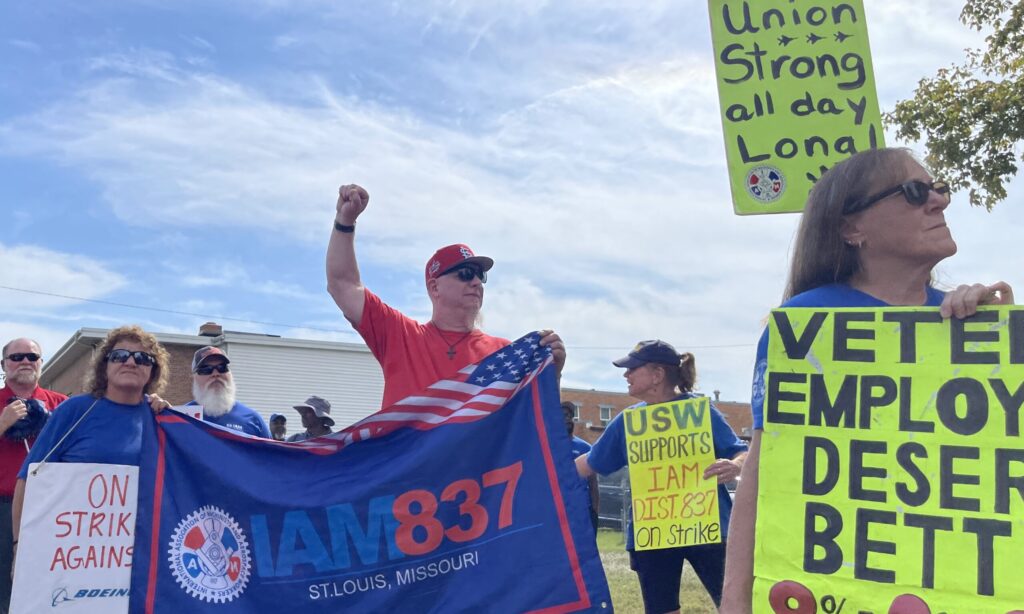
Boeing Defense workers on strike rally on Oct. 1 at the IAM Union Hall in Hazelwood (Rebecca Rivas/Missouri Independent).
Boeing’s decision to use replacement workers to complete fighter jet projects in St. Louis has once again put the company at odds with members of the U.S. Senate.
Three months after union workers walked off the job on strike, five Democratic senators pilloried the plan for replacement workers as potentially putting the nation’s military at risk.
“For existing projects, such as the F-15 Eagle and the F/A-18 Hornet, you are also unnecessarily endangering our warfighters by insisting on proceeding with an untrained and hastily recruited workforce,” says a letter the senators sent Tuesday to Boeing’s President and CEO Kelly Ortberg.
It was signed by U.S. Sens. Tammy Duckworth of Illinois, Elizabeth Warren of Massachusetts, Richard Blumenthal of Connecticut, Mazie K. Hirono of Hawaii and Elissa Slotkin of Michigan.
Also Tuesday, Republican U.S. Sen. Josh Hawley of Missouri sent his own letter to Ortbrerg, demanding the company negotiate in good faith with striking workers.
“These workers help produce our Nation’s most crucial, most advanced, and most expensive defense tools,” Hawley wrote. “And since your company receives billions in government contracts, it is incumbent upon you to do the right thing.”
More than 3,200 workers are on strike at Boeing’s three facilities in St. Louis, St. Charles and Mascoutah, Ill. They’re members of the International Association of Machinists and Aerospace Workers Union.
Strike negotiations have reached a stalemate, as Boeing refuses to add more money to any agreement and union members refuse to come back to work until they do.
Boeing did not immediately respond to The Independent’s request for comment on the senators’ letter.
Last week, Steve Parker, executive vice president of The Boeing Company and president and CEO of Boeing Defense, Space & Security, wrote employees a letter stating the company is “moving forward with the next phase of its contingency plan.”
“We are accelerating our efforts to hire permanent replacement workers, which will likely result in some striking employees being displaced,” he said.
Parker also said Boeing will be “expanding the use of third-party support for certain jobs and assessing opportunities to streamline factory operations.”
“And we’re welcoming back teammates who are crossing the picket line as we continue to hear from more teammates who tell us they are ready to come back to work,” Parker said in his email to employees.
Union leaders say the people who would provide the necessary training to certify these replacement employees are on the strike line. In their letter, the Democratic senators note that St. Louis-area facilities are crucial to the construction of the new F-47 fighter jet and NGAD fighters.
“If you choose to proceed with replacement workers to complete these projects, you will be sacrificing the needs of the U.S. military in order to benefit the corporation’s bottom line,” the letter states. “Rather than proceeding down this dangerous path, we urge you to rededicate yourself to meeting the needs of your current workers, who are a fount of experience, knowledge and professionalism.”
Pressure from Congress urging Boeing to cut a better deal for its workers has continued to grow these last month, as more senators have said the strike is threatening national security.
Hawley has repeatedly slammed Boeing for its behavior in the strike negotiations, including at a Senate hearing last month where others also voiced their outrage.
Members of the U.S. House Armed Services Committee sent a letter to Boeing Defense last week urging its leaders to offer a fair contract in the name of national security.
Earlier this month, the U.S. Airforce acknowledged that the 86-day strike at Boeing’s St. Louis facilities has delayed the delivery of F-15EX fighter jets, according to answers Gen. Kenneth S. Wilsbach provided to a U.S. Senate committee in his nomination for Air Force chief of staff.
Boeing workers have voted against four of the company’s contract offers, which all failed to include the 401(k) 100% match that workers have been demanding since the strike began on Aug. 4 as well as their proposed raise increase and signing bonus.
Jody Bennett, resident general vice president of International Association of Machinists and Aerospace Workers Union, said Boeing’s latest offer was “barely a shuffling” of prior offers.
The union gave the company a counter offer last week that took the 401(k) 100% match off the table and broke up their requested $10,000 bonus by getting $5,000 the first year and $5,000 in the third year.
The company rejected it. Parker wrote in his letter to employees that the union “asked for more money after we’ve repeatedly said more is not coming.”
In a statement Tuesday, the union said the difference between the IAM Union’s proposal last week and Boeing’s last rejected offer is roughly $8 million over four years, and called it “a fraction of what the company spends on executive bonuses and makes from the world-class defense products our members produce.”
“Boeing needs to bargain its way out of this strike — and your IAM Bargaining Committee remains ready to bargain in good faith when they are,” it states.