Judicial backlash against the Second Reconstruction Era of the 1960’s

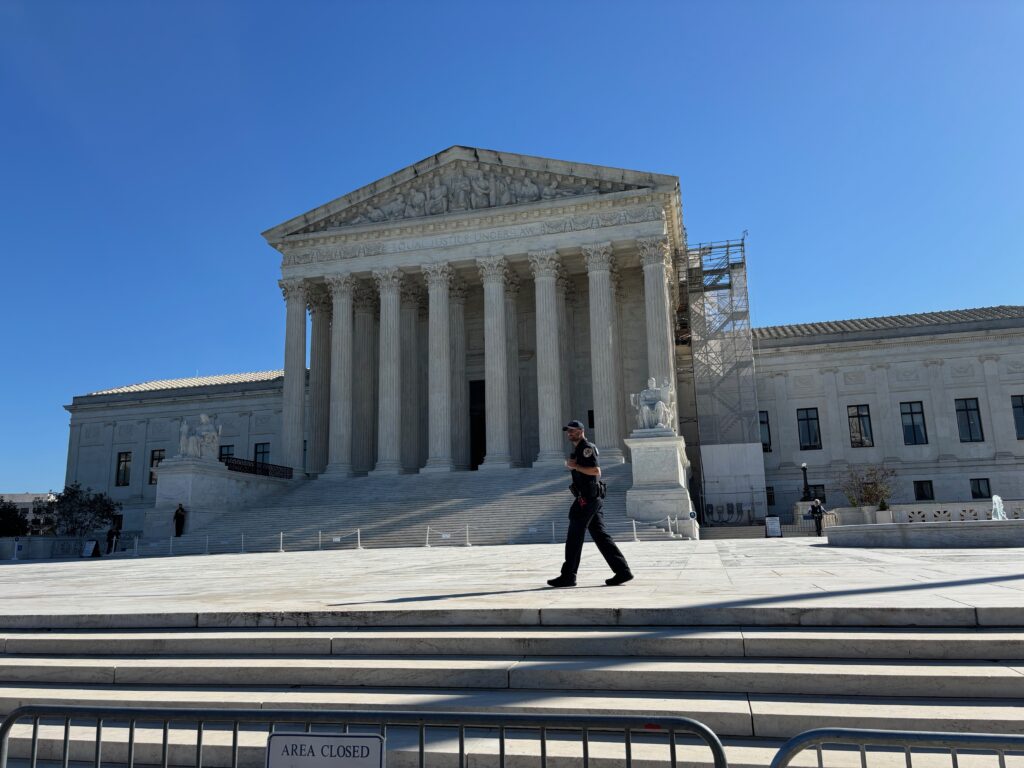
The U.S. Supreme Court on Oct. 29, 2024. (Photo by Jane Norman/States Newsroom)
The U. S. Supreme Court just issued its decision in Louisiana v. Callais.
By a 6-3 vote, the conservative majority of the court effectively gutted Section 2 of the Voting Rights Act by allowing states to dilute the voting power of minority voters.
Justice Samuel Alito wrote the majority opinion. While characterizing the decision as consistent with his view of the 15th Amendment, Justice Alito effectively reinstated a Louisiana map that provides for only one Black majority congressional district – even though black voters comprise a much larger share of the state’s voting population.
Alito did not consider this dilution of voting power to be an act of intentional racial discrimination. In response to the decision, Louisiana Gov. Jeff Landry suspended voting in that state’s primary and wants state lawmakers to draw a new map to dilute the black vote even more.
Technically, the court struck down a revised map that was intended to comply with Section 2. In a weird twist of logic, Alito considered the revised map to be the product of improper racial gerrymandering.
That is, Alito considered it unconstitutional for the state to consider race as a remedy to correct what the lower court deemed an unlawful map. According to Alito, the state did not need to create a second majority black district to comply with Section 2.
The court created a new “updated” totality of the circumstances test that will be virtually impossible for plaintiffs to satisfy. The most troubling part of this new multipart test is how to deal with state claims of partisan gerrymandering.
To prove intentional discrimination, the plaintiffs now must rule out the competing explanation that politics dominated the redistricting effort. If either politics or race could explain the contours of the map, the plaintiffs have not met their “special” burden. In other words, so long as the state can invoke the cloak of partisanship, the plaintiffs will lose.
I find it odd that Justice Alito would elevate partisan gerrymandering – a tactic most Americans oppose – to be an absolute wall of defense against the charge of racial discrimination. What have we come to?
In a concurring opinion, Justice Thomas and Justice Gorsuch would have gone further and ruled no Section 2 redistricting challenge could ever succeed.
Justice Kagan expressed outrage in her dissenting opinion. Justices Sotomayor and Jackson joined in the dissent.
Kagan charged the majority with eviscerating Section 2 by holding, in effect, that “a State can, without legal consequence, systematically dilute minority citizens’ voting power.”
Yet, the majority did not announce its holding that way. Instead, Kagan described the majority opinion as “understated, even antiseptic.” But how can such a harsh result possibly be consistent with Section 2’s explicit prohibition against racially discriminatory practices in voting rights?
Kagan recounts the full history of the Voting Rights Act and its amendments to show how Congress chose to deal with the dilution of minority voting rights in redistricting cases. The majority opinion brushed aside those choices with its “updated” Section 2 test. Kagan declared: “The consequences are likely to be far reaching and grave. Today’s decision renders Section 2 all but a dead letter.”
Kagan felt so strongly about it that she read her dissent from the bench.
In Missouri, the Supreme Court has effectively blessed the state legislature’s attempt to dilute the black vote in the 5th Congressional District in Kansas City. Unless Missouri voters are allowed to intervene through the referendum process, Emmanuel Cleaver’s distinguished career in Congress appears doomed to end.
I consider this to be unfair and discriminatory – both to Cleaver and to the voters in the current Fifth Congressional District. Will Wesley Bell of the 1st District be Missouri’s next target? Tragically, the Callais decision invites red states to race to the bottom and to remove black legislators from Congress.
I totally agree with Justice Kagan’s view that the Callais decision will have grave and far-reaching consequences.
I’m afraid we’re now living through the judicial backlash against the second reconstruction era of the 1960’s. What Congress created can now be eviscerated by an activist judicial interpretation.
This concept is not original with me. Kevin Gaines wrote about “The End of the Second Reconstruction” in an article published by the Cambridge University Press in 2018. Others have written on the topic as well.
Is the Civil Rights Act of 1964 next on the agenda? The Court has already taken indirect potshots at the law by eliminating affirmative action in college admissions and by relaxing the burden for an employee to prove reverse discrimination. An employee in the majority bears no greater burden of proof than a minority member of a protected class under the law.
The Trump administration is using these kinds of decisions to justify its polarizing attacks on DEI. What’s next?