Plan to replace income tax with expanded sales tax clears Missouri House

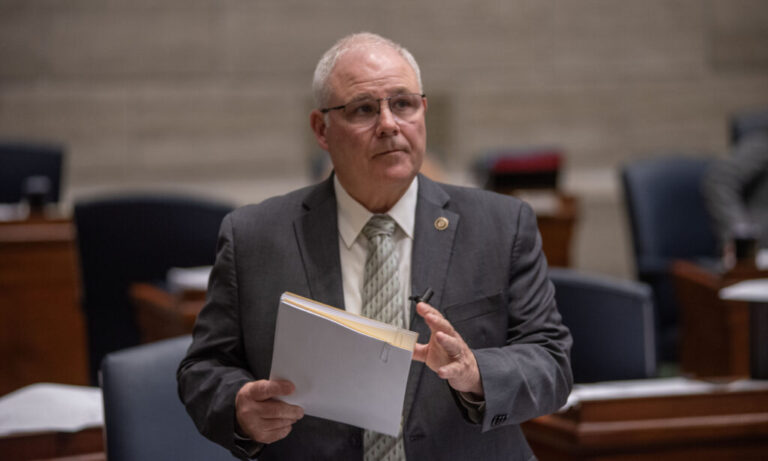
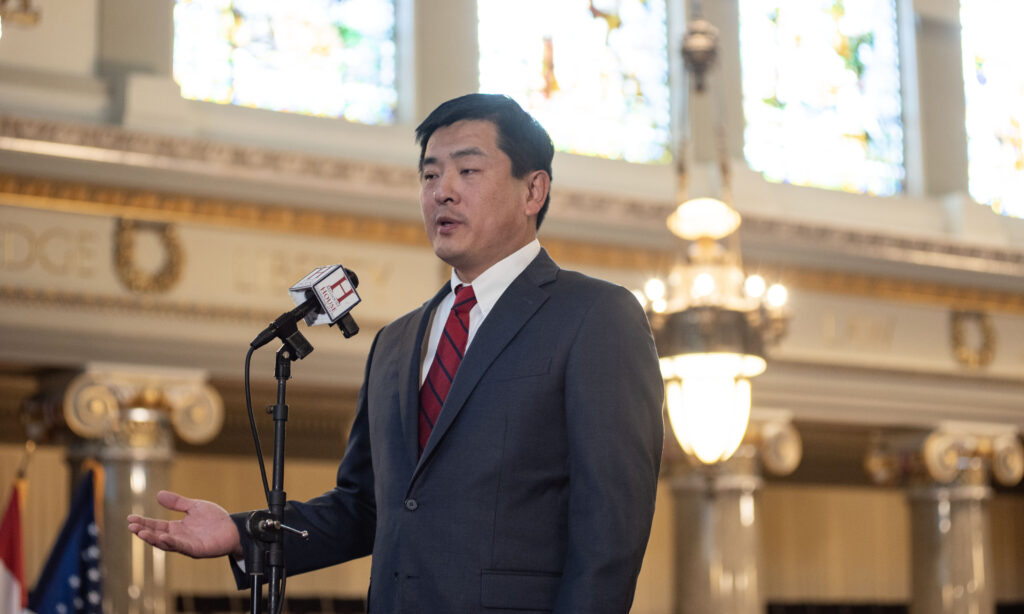
Missouri House Speaker Jon Patterson, a Republican from Lee’s Summit, speaks Thursday during a mid-session press conference (Annelise Hanshaw/Missouri Independent).
The proposed constitutional amendment asking Missourians if they want to replace the income tax by adding a sales tax to services and other transactions moved one step closer to the ballot Thursday when it passed the state House on an almost pure party-line vote.
If it passes the Senate and is approved by voters, the measure would give lawmakers three years to decide which currently untaxed goods and services would lose their exemption to generate the money needed to replace the revenue from income taxes. The top income tax rate would decline by 0.01 percentage points for every $20 million in general revenue in excess of the $13.43 billion collected in the year that ended June 30.
The bill passed the House on a 98-54 vote on the last day before lawmakers take a week-long Spring Break. Only one Democrat, state Rep. Marlene Terry of St. Louis, supported it, and only four Republicans — state Reps. Mazzie Christensen of Bethany, Brenda Shields of St. Joseph, Gregg Sharpe of Ewing and Rudy Viet of Wardsville — opposed it.
The proposal now moves to the Senate, where Republican leaders have proclaimed it a top priority and Democratic leaders said Thursday they have strong misgivings.
Gov. Mike Kehoe pledged during his 2024 to eliminate the income tax, and he entered the 2026 session with the amendment sitting atop his legislative agenda. If successful, the income tax would no longer be in place by the start of 2032.
Gov. Mike Kehoe wants voters to decide whether Missouri should eliminate its income tax
During the House debate, Democrats warned that Republicans were putting state services, including public schools, in danger of cuts if revenue replacement taxes do not produce the expected revenue.
State Rep. Yolanda Young, a Kansas City Democrat, said haircuts, salon visits and plumber services are among the items likely to be taxed if the measure passes at the ballot box.
“If the income tax disappears, the burden will not disappear with it,” Young said. “The burden shifts to you.”
Democratic opposition is based on “lies,” said state Rep. Bishop Davidson, the Republican from Republic sponsoring the proposed constitutional amendment.
“The only thing it does is utilize growth to reduce the income tax over time,” Davidson said. “It gives the growth back to the people, and it also allows us to hasten that process.”
Missouri has an almost flat income tax, with the top rate of 4.7% imposed on taxable incomes greater than $9,436. There are two 0.1 percentage point reductions already in state law when revenue grows by $200 million or more in a single fiscal year.
Growth was below that level in the most recent fiscal year and revenues are projected to decline in the current year. The next statutory reduction in income taxes is unlikely before Jan. 1, 2028.
The proposal would give lawmakers broad authority to decide which transactions currently untaxed would be covered by an expanded sales tax.
State Rep. Mark Matthiesen, a Republican from O’Fallon, said he was uncertain about the measure when the session began but now supports it. He warned that lawmakers will be under intense pressure if it passes as the General Assembly works on a sales tax bill.
“We are going to have special interests from all over the state knocking on our doors,” Matthiesen said.
Missouri currently imposes a 3% sales tax for general revenue, plus 1.225% earmarked for particular programs. Local option sales taxes are added to the 4.225% total, and there are more than 50 locations in the state where the total sales tax is 11% or higher.
Each 1% of the general revenue sales tax generates about $1.1 billion. To replace the money raised from the income tax could add 8% or more to the current rate.
To generate enough revenue to replace the income tax without increasing sales tax rates would require finding more than $300 billion of transactions currently untaxed, Matthiesen said.
“If we send this to the voters, we are asking the voters to trust us,” he said.
The measure allows lawmakers to tax any goods or services sold in the state and puts the money in the general revenue fund. It exempts any sales tax applied to gasoline from current constitutional provisions sending revenue from fuel taxes to the state Road Fund.
New Missouri income tax cut plan could allow first-ever sales tax on gas and diesel
At a news conference Thursday, House Speaker Jon Patterson, a Lee’s Summit Republican, said that while the measure would allow a sales tax on gas, it is politically off-limits.
“I can’t think of anything less popular back home than imposing another tax on gas, especially with the way gas prices are going now,” Patterson said. “I just. cannot see that happening.”
Patterson calls the measure a “modernization” of Missouri’s tax system. The state income tax was first imposed in 1917 and the sales tax on tangible goods was put in place in the 1930s.
Along with the requirement that fuel taxes pay for roads, the measure would also exempt a new sales tax base from constitutional provisions that put goods and services not currently taxed off-limits to lawmakers.
“It is a modernization,” Patterson said. “It’s not just an increase in sales taxes.”
Opponents are raising fears because they don’t want change, he said.
“When you try to do something really transformative, it’s not easy,” Patterson said. “There are so many opposing forces and just the inertia factor alone, it’s just much easier to say, ‘let’s just do what we’ve been doing and hope for different results’.”
Republican leaders in the state Senate said at a news conference that they welcome the House passage. Their plan had been to wait for the House to act before moving on tax legislation, said Senate Majority Leader Tony Luetkemeyer, a Parkville Republican.
He said he hopes to find a compromise Democrats can accept, he said.
“We look forward to negotiating with them in the second half” of the session, Luetkemeyer said.
Making big changes in tax structure is troubling as Missouri is facing a financial cliff, said Senate Minority Leader Doug Beck, a Democrat from Affton.
The budget for the coming year would use most of the available surplus in the general revenue fund. Future budgets, to be in balance, would have to be cut by more than $1 billion or lawmakers would have to find that amount to maintain services.
“We believe that we have to have the revenue to take care of those things,” Beck said, “while at the same time, we believe it’s important that working families have real relief.”