Missouri bill targets ‘date rape’ drugs after lawmaker suspects she was drugged

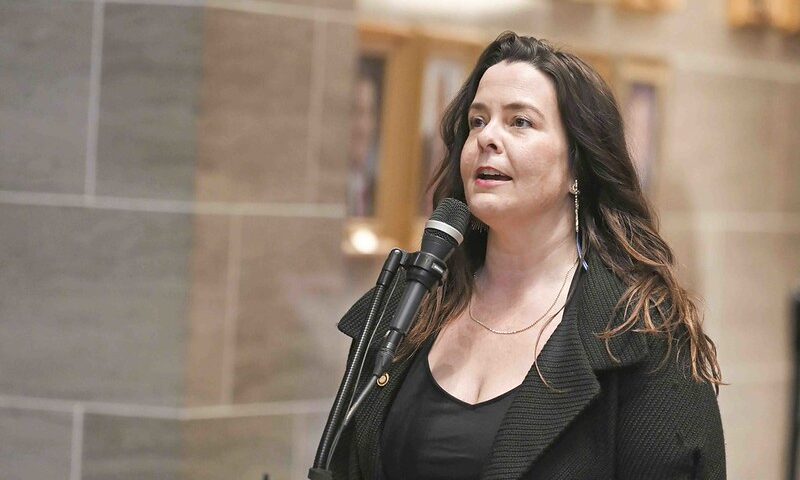
State Rep. Elizabeth Fuchs, a St. Louis Democrat, speaks during Missouri House debate in May 2025 (Tim Bommel/Missouri House Communications).
When state Rep. Elizabeth Fuchs first arrived in Jefferson City as a lobbyist in 2015, a woman who had been around the Capitol longer pulled her aside and offered advice that sounded, at first, absurd for a statehouse job.
Don’t drink from the “special refrigerator” in someone’s office. Don’t go for one-on-one drinks after hours. Don’t accept an open beverage you didn’t see poured.
“Are you telling me how to conduct myself at the Capitol,” Fuchs remembered thinking, “or are you telling me how to conduct myself at a frat party?”
For years, Fuchs, a St. Louis Democrat, followed the rules — and then she won a seat in the Missouri House in 2024 and joined the place she had learned to navigate as if it came with its own set of hazards. During her first session last year, she said, she broke one rule: she took a drink from someone she didn’t know well.
After that, her memory collapses into gaps.
The next day she was sick and disoriented, trying to talk herself out of what her body seemed to be telling her. And near the end of the legislative session, she said, she watched something eerily familiar happen again, this time to a colleague who was perfectly coherent one moment and struggling to manage stairs the next.
On Monday night, Fuchs shared her story publicly during a hearing of the House Emerging Issues Committee as she introduced legislation meant to stiffen penalties for certain substances commonly linked to drink-spiking and sexual assault.
The bill would classify several “psychoactive substances” as Schedule I controlled substances alongside heroin and marijuana. It would increase penalties for possession and distribution in an effort, Fuchs said, to deter people from carrying drugs that have few legitimate explanations in social settings and to respond to the reality that some of them can be difficult to detect after the fact.
“I broke my own rule,” Fuchs said in an interview Tuesday morning, describing a particular kind of guilt that can attach even to suspicion. That shame, she said, is part of why incidents go unreported. The drugs leave the body quickly, she said, victims second-guess themselves and the window for proof closes fast.
House Minority Leader Ashley Aune, a Kansas City Democrat, told the committee she questioned whether she, too, had been drugged last year after a night in Jefferson City when she had been drinking only club soda. She suddenly felt inebriated, she said, and spent the next day vomiting.
In an interview with The Independent, Aune said she personally knew of three instances last year involving lawmakers — herself, Fuchs and another colleague — and that even when women believe something happened, many talk themselves out of it before they ever consider filing a police report.
Too often, Aune said, the default is to assume it was their fault. And in politics, she added, doubt has a way of metastasizing into risk.
“Because there is this atmosphere of a kind of a good old boys club,” she said, “it’s just hard for women to feel heard or to feel like they’ll be taken seriously.”
Missouri state senator says a ‘sexual predator’ works in the Capitol Building
In many workplaces, Aune said, accusing a colleague or superior can be professionally perilous. In a statehouse, she said, it can also become partisan ammunition, a reputational weapon or a reason for allies to quietly step away.
“So many women are afraid that they will get marked with a scarlet letter,” she said.
The instinct to minimize is one of the Missouri Capitol’s most durable traditions. In 2015, after House Speaker John Diehl resigned amid revelations of sexually inappropriate texts with a 19-year-old intern and state Sen. Paul LeVota stepped down following allegations of harassment and retaliation from interns, lawmakers promised a cultural reset.
Training was mandated. Complaint procedures were tightened. Leaders spoke of professionalism.
But the building’s warnings have endured, passed down like folk wisdom from older women to younger ones, from lobbyists to interns to legislators.
Last spring, a debate in the Missouri Senate veered abruptly into an accusation that a “sexual predator” was working in the Capitol — and that “powerful people” knew who it was and were protecting them. The lawmaker who made the claim, Democratic state Sen. Stephen Webber of Columbia, said he could not reveal the person’s identity because he had promised confidentiality to victims.
But the charge — aired in the open, with no name attached and no clear path to accountability — landed as a kind of institutional indictment.
It is against that backdrop that Fuchs describes her legislation as both policy and signal, a way of saying out loud that the old rules exist for a reason and that the people who pass them down are not being dramatic.
Fuchs said she first saw a version of her proposed legislation while scrolling social media and reading about a German effort to increase penalties tied to certain “date rape drugs.” The feeling that followed was a desire to make clear, in Jefferson City, that the problem was not imaginary and would not be ignored.
“We know what’s going on here,” she said.
Aune put it more plainly, as a warning that sounds familiar in a place that keeps needing it.
“Watch yourself everywhere you go,” she said. “Be aware who is pouring the drink. Be aware who is handing it to you.”