Missouri may finally be done looking the other way on gray-market slot machines

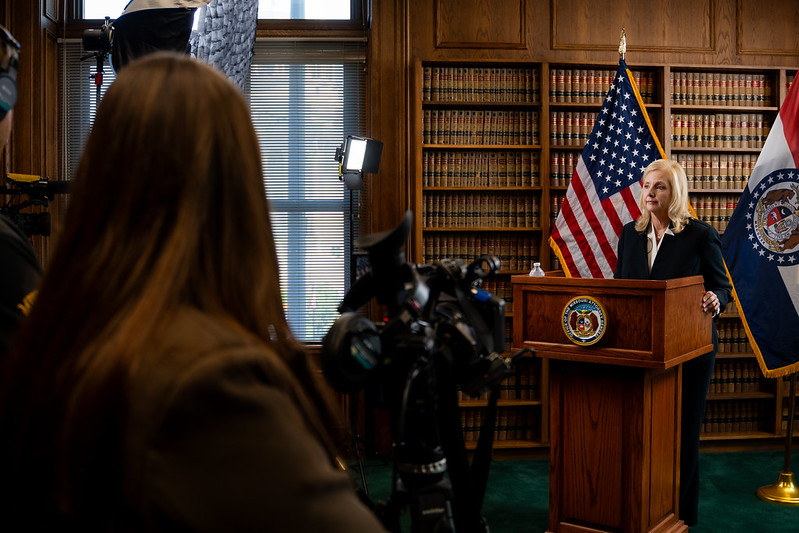
Missouri Attorney General Catherine Hanaway speaks to the media shortly after being sworn into office on Sept. 8, 2025 (photo courtesy of the Missouri Attorney General’s Office).
If you ever want to know what’s really heating up in the Missouri Legislature, skip the floor debates and committee hearings. Check the lobbyist registrations at the Missouri Ethics Commission.
A prime example is the push to legalize video lottery terminals — aka, those slot machines you see at gas stations.
This isn’t just a policy debate. It’s a full-on lobbying arms race between Illinois-based J&J Ventures and Wildwood-based Torch Electronics, a fight that has put around 30 lobbyists to work inside the Capitol.
Some names will sound familiar.
J&J brought former House Speaker Dean Plocher onto their team. Torch relies on the lobbying firm of former Speaker Steve Tilley.
(Fun fact: in my 15 years covering Missouri politics, eight men have served as House speaker. Five became lobbyists. One is still speaker. One hosts a conservative radio show and does political consulting. One pleaded guilty to federal wire fraud.)
Then there’s the money. J&J Ventures donated $1.2 million last year, mostly to PACs run by its lobbyists. Torch isn’t far behind: $650,000 to PACs run by Tilley, with Warrenton Oil — whose convenient stores are home to many Torch machines — contributing another $135,000.
That money has been sprinkled out to various lawmakers, including more than $100,000 to a PAC supporting House Speaker Jon Patterson.
Of course, lobbying and PAC money only go so far. The state’s budget is proving to be a real motivator. Missouri’s revenue surplus is nearly gone, and expanding gambling is one of the few ways to bring in cash without raising taxes.
Missouri is littered with “gray-market” machines in bars, restaurants and convenience stores. Torch, the most visible operator, insists they aren’t gambling devices and are completely legal.
For years, attempts to crack down were met with well-funded pushback from Torch. Meanwhile, J&J urged lawmakers to establish a regulatory framework that would give it a path to operate legally in the state.
This year, Torch stood down once the bill included a two-year window to remove illegal machines and an opt-out clause — rather than an opt-in — for local governments wanting to ban them.
Another possible motivation for Torch dropping its opposition? Perhaps it sees the writing on the wall.
The company’s argument that its machines are legal took a hit in October, when a federal jury concluded the games meet the state’s definition of illegal gambling devices. The same month, Torch lost a lawsuit seeking to repeal Springfield’s ban on video lottery terminals.
Adding to the company’s headaches, Attorney General Catherine Hanaway is promising a crackdown. She made it clear to legislators last week: Torch machines are illegal.
She’s also assisting with a federal investigation into illegal slot machines in Missouri involving what she described as “money laundering and banking” questions.
That’s a sharp break from her predecessor, Andrew Bailey, who pulled out of defending the Missouri State Highway Patrol in a lawsuit filed by Torch after a PAC funded by the company donated to his campaign.
Back in the Capitol, the Missouri House seems poised to pass legislation legalizing video lottery terminals. But its chances are slim in the Senate, and it faces fierce resistance from Missouri’s 13 casinos, which operate under strict state regulation, aren’t eager to see every gas station become a gambling competitor and have deployed their own phalanx of lobbyists.
Without a legislative fix, here’s the bottom line: Missouri doesn’t have a gambling problem, it has a gambling enforcement problem.
These slot machines didn’t appear overnight. They’ve been operating openly for years, pretending to exist in some sort of legal fog and daring the state to act.
Hanaway seems ready to take that dare.