State highlights women who regret abortions in emotional appeal for Missouri regulations

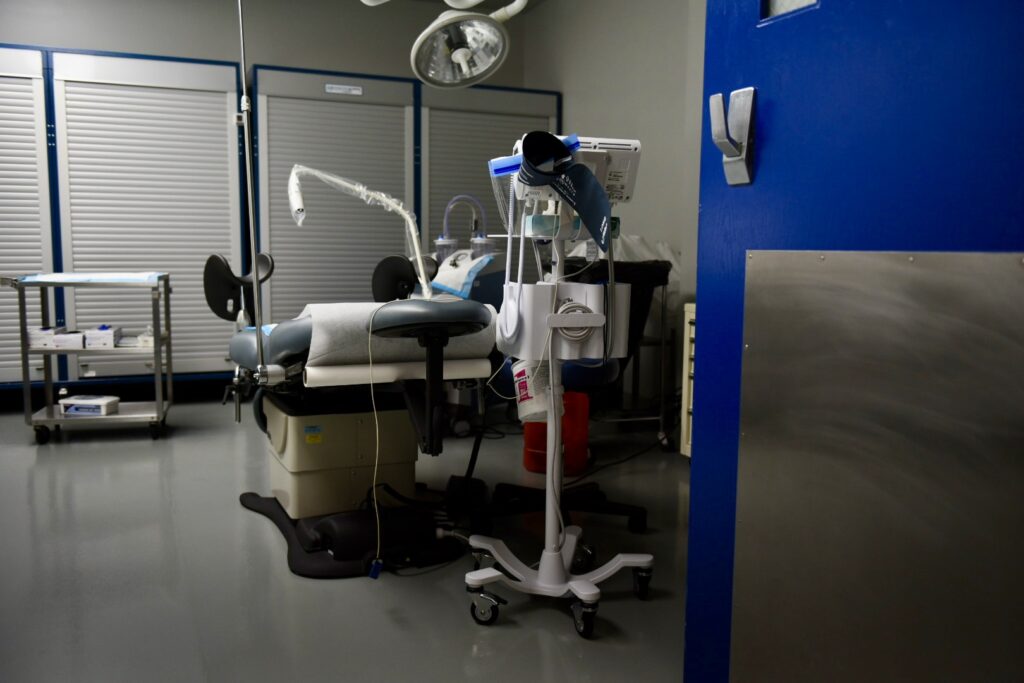
A surgical room is prepped for patients on Friday, June 21, 2024, at Planned Parenthood Great Plains in Overland Park, Kansas (Anna Spoerre/The Missouri Independent).
KANSAS CITY — A trial focused on the constitutionality of abortion access in Missouri included testimony from a range of witnesses, but only four who had undergone abortions. All four said they regretted ending their pregnancies.
The state rested its case Friday after bringing to the stand a panel of witnesses who argued abortion is harmful to women and should be governed by strict regulations. It’s the same argument Missouri’s anti-abortion movement continues to make the focus of its campaign to ban the procedure.
With the trial scheduled to end Monday, the state capitalized on emotional testimony in an attempt to prove its case that these regulations, which have crippled Planned Parenthood’s ability to perform abortions, are necessary safeguards.
Planned Parenthood and the ACLU of Missouri, which sued to strike down the laws under the state’s new voter-approved reproductive rights amendment, have argued the laws are discriminatory and unconstitutional because they have prevented tens of thousands of Missouri women over the past several years from accessing abortion without crossing state lines.
State attorneys leaned on the stories of women who sought abortions decades earlier at Missouri Planned Parenthood clinics, before the procedure, its providers and its clinics were more heavily regulated. The four described impersonal visits and overcrowded dark rooms with heavy, sad atmospheres where women were often crying.
“The abortionist came in from a side door,” testified Stephanie Jacobson, using an anti-abortion pejorative for the doctor, about the first abortion she had when she was 16 in 1978. “It was very excruciating. I must have been squirming, because they kept saying, ‘Lay still.’”
After her second abortion in 1982, this time at a local hospital, Jacobson said she miscarried another pregnancy and attributed it to her abortions. She went on to give birth to five children.
But until about nine years ago, when Jacobson said she completed an abortion recovery counseling program, she said she was depressed, angry and had thoughts of harming herself because of the choice she’d made.
The requirement that Missouri’s 26-page informed consent booklet be given to every woman seeking an abortion is one of the challenged laws in the case. While it does mention that a provider must inform the patient of “possible adverse psychological effects associated with the abortion,” it does not go into any further detail about those effects or provide any basis for the statement.
Missouri regulator says abortion clinics faced heightened scrutiny unrelated to safety
Marilyn Cox, of Hillsboro, said she was going through a divorce in 1980 when she was seeing another man and got pregnant. For financial reasons and because she “didn’t want to face” her dad, she had an abortion.
Cox said the Planned Parenthood she went to did not properly inform her of the development of the fetus in the womb at eight weeks. She testified that she would not have gone through with the abortion if she knew that, or if she had seen it on an ultrasound.
After that, she described two near-suicide attempts, one that occurred about a year after the abortion.
“I hated my guts,” she testified.
Linda Raymond took the stand on Tuesday and spoke about the effects of her abortion in 1976, saying she had depression, anxiety, nightmares and flashbacks, and is still on an anti-depressant today. Like Jacobson, she said she found a “post-abortive” counselor to help her through it.
And Crystal Lane had an abortion in 2009, during a divorce when she was dating someone else. Lane said she didn’t want to bring more children into a volatile family situation, as she already had two at home.
“No one at the (Planned Parenthood) clinic coerced me, but I wasn’t told how it would affect me,” Lane said.
Lane said she’d had some substance abuse issues before the abortion, and later became addicted to methamphetamine. She said it wasn’t until she went through a program focused on healing from abortion that she could process the trauma. The program encouraged her to name the fetus she aborted, and she now has the name “Starling” tattooed above her right eyebrow.
During cross-examination of the witnesses, attorneys for Planned Parenthood pointed out that three of the four women testified they had been abused by someone close to them. Raymond said her mother physically abused her, Lane said her ex-husband and father were abusive and Cox said her previous marriage was abusive.
Many studies show women who experience intimate partner violence are at increased risk for developing mental health problems, including post-traumatic stress disorder, depression and substance abuse disorders.
Attorneys for Planned Parenthood affiliates and the ACLU of Missouri repeatedly challenged the relevance and expertise of the state’s witnesses on scientific and relevancy grounds, leading to drawn-out exchanges that eventually drove Deputy Solicitor General Peter Donohue to accuse the other side of purposely doing it to “run out the clock.”
But the witnesses still provided plenty of testimony, despite the objections.
An Ohio nurse practitioner named Maureen Curley testified that although she hadn’t referred anyone for an abortion in 20 years, her counseling of patients who had abortions led her to believe that motherhood is protective, and giving birth is “psychologically safer” than abortion.
She said even in a case like the 10-year-old girl in Ohio who was pregnant as a result of incest and had to travel to Indiana for an abortion, giving birth would be more protective from a mental health standpoint.
Abortion safety takes center stage as Missouri trial enters second week
St. Louis Dr. Andrew Steele, an OB-GYN who largely performs pelvic-related surgeries, said he’s seen four cases of abortion complications between 2009 and 2023. And one California doctor who had performed a different type of abortions than today’s practice between 1987 and 1994 was largely excluded from testifying after the plaintiffs objected.
Plaintiffs unsuccessfully sought to exclude the testimony of Priscilla Coleman, a retired professor of human development and family studies who frequently writes and testifies against abortion. Coleman’s papers, some of which have linked abortion to increased risks of mental health problems, have faced criticism and even retraction.
On cross examination, attorneys for Planned Parenthood tried to accuse Coleman of cherry picking data points and studies that supported her anti-abortion views. Coleman provided an expert report in the case and told the court she had read each of the 280 papers she cited in that document. But she acknowledged she removed one of her citations of a study published only in Turkish, which she does not speak, after it was pointed out by plaintiffs.
Coleman testified she believed abortion should be illegal in almost all cases, including rape.
She acknowledged that the American Psychological Association, the National Academy of Sciences and the United Kingdom’s Royal College of Psychiatrists have all concluded that scientific literature shows no association between abortion and adverse mental health, but said scientists were breaching ethics to advance abortion rights.
“I believe there’s an effort to distort the literature,” she said.
A temporary injunction blocked most of Missori’s abortion regulations pending trial. Until a ruling is made, the Planned Parenthood clinics in Kansas City, Columbia and St. Louis continue offering appointments for procedural abortions. Medication abortion remains unavailable.
Stateline’s Kevin hardy and The Independent’s Anna Spoerre contributed to this story.