Mike Kehoe says Missouri is falling behind. His solution: more tax cuts

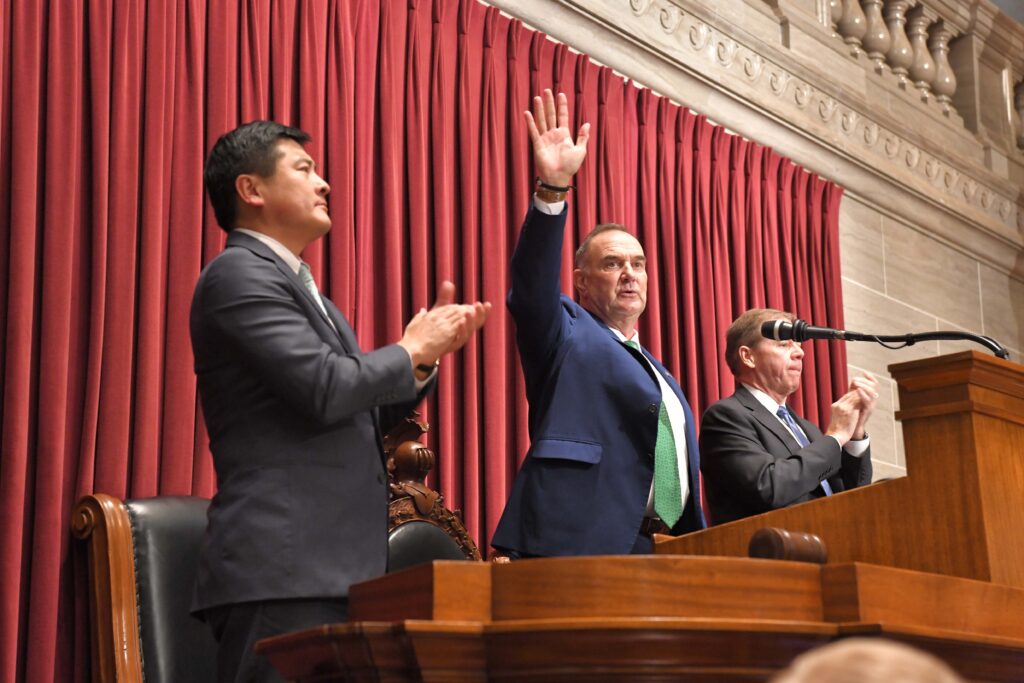
Missouri Gov. MIke Kehoe waves after completing his 2026 State of the State address on Jan. 13, as House Speaker Jon Patterson claps in the foreground (Tim Bommel/Missouri House Communications).
Gov. Mike Kehoe’s State of the State address rested on a tension he never resolved.
Missouri, he warned, is falling behind. Its population is “stagnant.” Economic growth over the past decade has been “average at best.” When competing with states like Texas and Tennessee, Missouri too often loses before the conversation even begins.
Yet in the same breath, Kehoe insisted Missouri has “already seen success” cutting taxes. Over the last decade, Missouri has trimmed the income and corporate taxes while eliminating the franchise and capital gains taxes. This argument did much of the heavy lifting for the signature proposal in the speech: a five-year phaseout of the individual income tax.
But if tax cuts are already delivering growth, why does Missouri still lag its peers?
And if the state is falling behind, why double down on a strategy that has yet to close the gap?
The governor never reconciled that contradiction, even as he dismissed critics who argue tax cuts have worsened the state’s budget outlook as people who “just want to spend more of your money.”
There is also a political reality left unspoken.
Republicans have controlled the Missouri legislature for more than two decades and the governor’s office since 2016. The conditions Kehoe now decries did not arise in a vacuum. His agenda is not a sharp break from the past so much as an escalation of it — a bet that going further down the same road will finally produce different results.
Kehoe attempted to reassure skeptics by drawing bright lines. He pledged he would “never support” extending sales taxes to agriculture, health care or real estate. He described his plan as deliberate, responsible and safeguarded against runaway sales taxes.
But the language of the constitutional amendment introduced in the Missouri House the day Kehoe gave his speech — the apparent vehicle for that tax-cut promise — tells a different story.
The proposal explicitly allows state and local sales and use taxes to be expanded “to impose taxes on transactions involving any goods and services” for the purpose of eliminating the income tax.
Any resulting tax increase would be exempt from Missouri’s constitutional revenue limits and Hancock Amendment protections, meaning lawmakers could raise or broaden taxes without triggering the usual requirement to take the issue to voters.
Missouri revenue surplus nearly gone as Gov. Mike Kehoe unveils his budget plan
All of this is unfolding as Kehoe warns, in stark terms, that the era of pandemic-era budget surpluses is over and that federal funds that once bolstered state coffers are no longer filling gaps. He proposes roughly $600 million in cuts to the core operating budget while warning that the state’s revenue surplus of $4.3 billion on June 30 will be only $4.7 million next year.
This is not abstract belt-tightening. Kehoe explicitly warned lawmakers against restoring cuts or slipping pet projects into the budget without identifying how to pay for them. The message was unmistakable: lean years are coming, and discipline will be enforced from the governor’s office.
That context makes his tax plan more controversial, not less. States that have successfully eliminated the individual income tax typically rely on alternative revenue streams to balance their budgets, such as oil and gas production, massive tourism economies or both.
Missouri has none of those advantages on a scale large enough to matter.
The coming months will reveal whether Kehoe’s foundation for growth is solid — or whether the cracks he papered over in this speech widen under fiscal pressure.