State AGs push Bondi to support death penalty for child rapists

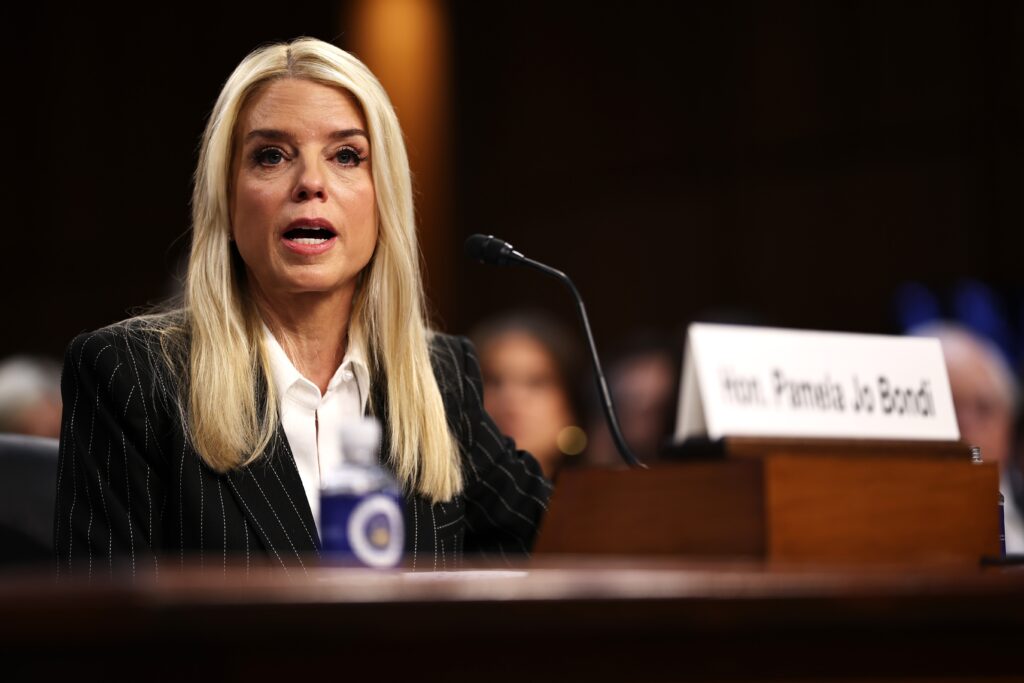
Former Florida Attorney General Pam Bondi testifies before the Senate Judiciary Committee during her confirmation hearing for U.S. attorney general in the Hart Senate Office Building on Capitol Hill on Jan. 15, 2025, in Washington, D.C. (Photo by Chip Somodevilla/Getty Images)
Louisiana’s Liz Murrill has joined attorneys general from 13 other states in asking the Trump administration to challenge a 2008 U.S. Supreme Court ruling that placed the death penalty off limits for persons who rape children.
The case in question involves a Louisiana man who was sentenced to death for sexually assaulting his 8-year-old stepdaughter. Justices set aside that punishment, ruling that it was “cruel and unusual” in violation of the 8th Amendment.
The attorneys general say the decision limits the authority of states to impose capital punishment.
Florida’s AG James Uthmeier sent a letter last month to U.S. Attorney General Pam Bondi and White House counsel Dave Warrington asking for their support of state efforts to uphold the death penalty in child-rape prosecutions. Murrill announced Wednesday she has added her signature to the letter, joining her fellow Republican counterparts from Alabama, Alaska, Arkansas, Idaho, Indiana, Missouri, Montana, Ohio, South Carolina, Tennessee, Texas, Virginia and West Virginia.
The Supreme Court decision stems from a Louisiana case in which Patrick O’Neal Kennedy was sentenced to death for the 1998 rape of his 8-year-old stepdaughter at his Jefferson Parish home. His punishment was cleared under a 1995 Louisiana law that expanded the use of death penalty for aggravated rape when the victim is under age 13. Kennedy was convicted in 2003 and sentenced to die.
His appeal ultimately landed before the Louisiana Supreme Court, which upheld the death sentence. State justices noted in their ruling that five other states had also enacted laws to allow capital punishment in child rape cases.
In its 5-4 decision, the U.S. Supreme Court found that five states did not constitute a “national consensus” on treating child rape as a capital offense.
Kennedy’s death sentence was converted to life in prison. Now 60, he is being held at the Elayn Hunt Correctional Center in St. Gabriel, according to state corrections records.
In his letter, Uthmeier said the 2008 ruling “acknowledged, though, the possibility of a ‘further or later consensus in favor of the [death] penalty’ that might … warrant a different result in future litigation.”
Toward that end, Florida two years ago reauthorized the death penalty for sexual battery committed against children under 12, Uthmeier wrote. The signatory AGs from states that have yet to permit executions for child rapists have committed to urging their state legislatures to approve such measures, he said. The letter asks Bondi “to support States’ efforts to pursue justice” by filing briefs to uphold the death penalty in child-rape convictions.
“We have every confidence that, with President Trump’s strong leadership and with principled, rule-of-law Justices on the Supreme Court, Kennedy’s days are numbered, and child rapists can be appropriately punished for their unspeakable crimes,” Uthmeier said.
Murrill was more direct in a statement she released about adding her name to the Florida attorney general’s letter.
“As I’ve stated many times before, child rapists deserve the death penalty,” Murrill said. “The United States Supreme Court needs to reverse this egregiously wrong ruling.”
The Louisiana Legislature has recently enacted harsher penalties for sex offenders who target children.
In 2024, Gov. Jeff Landry approved a bipartisan-backed measure to allow surgical castration for certain sex crimes when the victim is younger than 13.
Louisiana approved the use of chemical castration, a reversible procedure carried out through medication, in 2008 – the same year the U.S. Supreme Court ruled on the Kennedy case.
This story was originally produced by Louisiana Illuminator, which is part of States Newsroom, a nonprofit news network which includes Missouri Independent, and is supported by grants and a coalition of donors as a 501c(3) public charity.