Judge allows Mizzou Students for Justice in Palestine to join the Homecoming parade

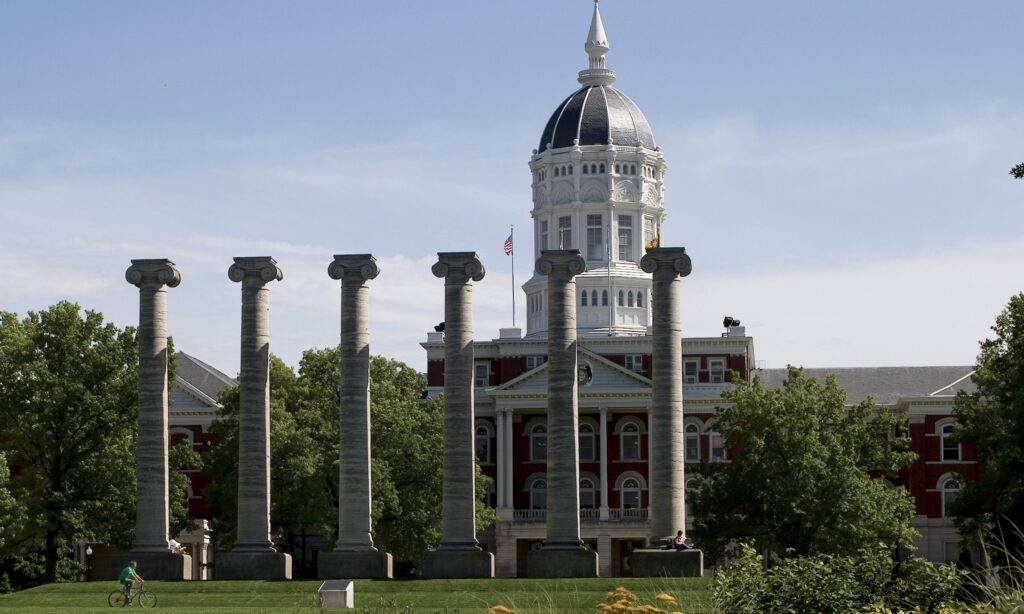
The iconic columns of the University of Missouri-Columbia campus (University of Missouri photo).
A federal judge ruled Friday that Mizzou Students for Justice in Palestine can participate in next weekend’s Homecoming parade, as long as they comply with the university’s parade policy.
In his ruling, U.S. District Judge Stephen Bough noted that while the court finds that the organization must be permitted to participate in the parade, nothing in the order prohibits the University of Missouri from enforcing the requirements of the parade policy.
The Council on American-Islamic Relations called the ruling a “major victory for the civil rights of all Americans,” according to a news release.
“This is a testament that we’re doing something right,” said Isleen Atallah, former president of MSJP. “We are as much a part of the Mizzou community as we think we are. Despite what the administration wants the public to believe, we’ve never been a threat, and we continue to not be a threat.”
Earlier this year, the university updated its Homecoming parade policy to exclude political expression. The new policy also denies participation of organizations that don’t adhere to the parade’s “black and gold” theme.
According to the updated policy, “the purpose of the Homecoming parade is to celebrate Mizzou and its supporters. It is not a venue for protests.”
Todd McCubbin, executive director of the Mizzou Alumni Association, told the judge during a hearing Tuesday that the organization’s 2025 application would likely be preliminarily approved, and the Office of Alumni Engagement would work with the group to ensure it complied with the parade policy. University spokesperson Christopher Ave declined comment on the judge’s ruling Friday.
Last month, Mizzou Students for Justice in Palestine sued Mun Choi, president of the University of Missouri System, to secure a place in the parade.
In the lawsuit, the group argued that Choi violated the students’ First Amendment rights by forbidding them to participate in the parade because of their views on Israel and Palestine.
In his ruling, the judge agreed with the organization that there is more than a “fair chance” that Choi’s denial of their participation in the parade violates the First Amendment.
“It’s a good feeling because we finally get to give the Mizzou community the performance it was robbed of last year,” said Lily Dunn, current president of MSJP. “It’s just so wonderful to know that we’re going to be able to show off Palestinian culture and all of these things to the community.”
In the Tuesday hearing, Choi’s legal team argued that the denial was largely based on safety concerns. They cited two prior incidents involving a member of the group that resulted in a student conduct charge for stalking and a restriction that limits her presence on campus to academic purposes.
The legal team also noted incidents of violence at student protests on other university campuses nationwide as part of Choi’s rationale.
The court agreed that safety is a “significant [governmental] interest,” but aside from the instances involving one group member, could not find that Mizzou Students for Justice in Palestine had violated any university policy.
Thus, Choi’s decision to exclude the organization on the basis of safety could not be supported.
According to the ruling, “Dr. Choi’s decision to exclude the organization in its entirety is not narrowly tailored to the stated interest of safety. Dr. Choi ‘could, instead, forbid the specific student(s) giving rise to [safety] concerns’ from participating.”
Thus, assuming the Homecoming parade is an unlimited public forum, the court found Choi’s decision had been too narrowly applied.
Ultimately, the court decided that there was little evidence that the students had been engaged in or connected to any form of violence, and that denying their participation in the Homecoming parade would likely be a violation of the First Amendment’s free speech clause.
“We are not concerning students, we are concerned students,” Atallah said. “If you put your mind to it and you have a genuine feeling and contempt that you are on the right side of history and you have been wronged, it’s not impossible to get justice and it’s not impossible to do what MSJP did.”
This article first appeared in the Columbia Missourian and has been republished by permission.