
Rudi ’splains it: Missouri property tax rates and how they are set

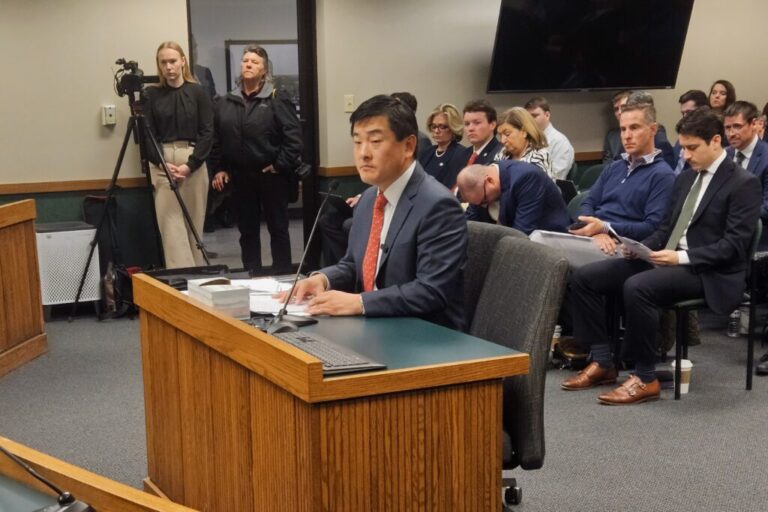
State Rep. Tim Taylor, a Boonville Republican, chairs the Missouri House Special Interim Committee on Property Tax Reform. (Rudi Keller/Missouri Independent)
Property tax rates for this year must be set by Monday in Missouri’s 2,807 local political subdivisions authorized to impose levies.
That starts the annual billing cycle, with each county collector using those rates and the property values determined by the county assessor to generate tax bills mailed in October.
By Dec. 31, every tax bill must be paid or penalties start accruing.
That’s the simple part of the process.
What is far more complex is the way rates are established. The starting point is the highest levy ever approved by voters within each city, county, school district or other agency.
Then mandatory adjustments are applied. They include factors such as real estate values, inflation, new construction, state sales tax revenue, car values, tax rate ceilings, tax rate floors, the Hancock Amendment, statutory limitations and some other things that make the list too long and confusing to continue.
Don’t worry. I’m here to help.
Welcome to the latest installment of Rudi ’splains it, The Independent’s irregular column where I try to tackle the details of something we will be writing about a lot. I’ve had a lot of experience covering local governments as well as state government, and have attended the meetings where no one shows up for the required public hearing on tax rates.
Missouri governor allows more spending, property tax cap as he pursues stadium deal
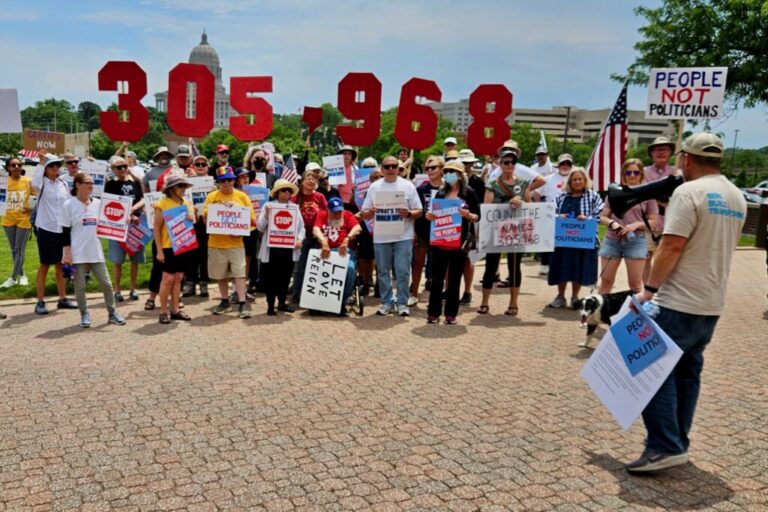
But the public has been complaining to the Missouri Legislature as bills increase. Lawmakers have responded by allowing counties to freeze bills for senior citizens, and when they met in June to vote on a $1.5 billion stadium financing bill, the Missouri Senate added 97 clauses to limit increases in individual tax bills for most counties.
And in the Missouri House, a 20-member special committee has held a series of hearings around the state as they study how property taxes could be simplified and made more predictable. The final hearing is set for Wednesday in Macon.
Statewide revenue from property taxes was $7.8 billion in 2024, second only to the income tax as a source of public funding in Missouri. But almost all the money goes to local agencies, so the only place to find the total is at the bottom of State Auditor Scott Fitzpatrick’s annual report listing every taxing entity’s rates after they are checked by his staff for accuracy.
One of my techniques for clearing a room is being a know-it-all on tax policy and bragging that I understand the Hancock Amendment better than just about anybody. This is my attempt to be both informative and at least mildly entertaining enough to keep you reading to the end.
And don’t worry. I am not writing what I think I know. Often, what I think I know isn’t correct.
Everything that follows, like everything above, is factual — and I checked.
The Single Tax
At the beginning of the 20th century, Winston Churchill became enamored with the work of American economist Henry George, who was convinced that land, as the source of all wealth, is the only thing that should be taxed.
“With the growth of population, land grows in value, and the men who work it must pay more for the privilege,” George wrote.
In 1908, Churchill was in full agreement with George. He later rejected the philosophy, but at the time, In speech to the House of Commons, he laid out principles for taxation that are generally applicable to all taxes and concerned foremost with the public good.
“The great principle which this House ought to guard and cherish is that, when the tax collector comes to the private citizen and takes from him of his wealth for the service of the public, the whole of that money taken shall go for the purposes for which it is intended, and that no private interests, however powerfully they may be organized and however eloquently advocated, shall thrust their dirty fingers into the pie and take the profit for themselves.”
Taxes should be understandable and changed only after careful study, he said.
The principles “are very simple,” Churchill said. “A child can learn them; only a fool can misunderstand them.”
Property tax terminology
I’ll wait until you have a child handy to help you understand what comes next.
Got one? Good.
Every individual property tax rate is stated as a dollar amount with a four-digit decimal, charged for each $100 of assessed value. For example, the Columbia Public Schools rate in 2024 was $4.7476 per $100 of assessed value.
What goes into determining that rate are all the factors that control property taxes. We’ll start with the terms that cover the value subject to the levy and then list factors that set the actual rates.
Appraised value is the assessor’s estimate of market value for residential and commercial property, the productive value of farmland or the “blue book” value of motor vehicles and personal property. Assessed value is the percentage of appraised value actually taxed, 12% for agricultural land, 19% for residences, 32% for commercial property and 33.3% for most personal property.
Using that Columbia school rate, a $250,000 property would pay $1,424 if it is a farm, $2,255 for a residence and $3,798 for a commercial property.
Each taxing district has a tax rate ceiling that is the highest levy the governing board can impose. The actual levy can be equal to the ceiling or some lower rate, depending on the action of the governing board and mandatory adjustments. School districts have a tax rate floor and must have a levy of at least $2.75 per $100 to qualify for state aid
The Hancock Amendment (no connection to our editor) is the name for the changes to the Missouri Constitution approved in 1980 to limit growth in tax revenue and require voter approval for local tax and fee increases. When property values rise because of the reassessment process, the Hancock Amendment requires tax rates to change to prevent agencies from reaping a windfall of new revenue.
The Hancock Amendment factors that determine whether rates change are the value of new construction and the inflation rate.
School districts have a second adjustment factor, tied to the 1% statewide sales tax known as Proposition C for the ballot title it carried in 1982. Half of the revenue from the tax is used to lower school property tax rates. Some local sales taxes are also written to have a portion of the revenue offset property tax rates.
Finally, rates must be adjusted under a state statute that limits the new revenue to any taxing district from rising property values to 5% if inflation is higher than that level.
Setting tax rates
When the Columbia City Council held its annual tax rate public hearing on Aug. 15, the only person who spoke was someone asking for a clarification when a staff member misspoke and said the sales tax rate was up for discussion.
The city staff calculated that the rate for 2025 after reporting that the assessed value of the city, after subtracting new construction, went up 7.3%. The allowed increase in total revenue from that tax base was limited to an inflation rate of 2.9%.
As a result, the rate was lowered from $0.4075 per $100 value to $0.3907 per $100.
The Columbia Board of Education, which held its tax rate hearing on Aug. 21, had the same factors — property values were up 7.3% and inflation was listed at 2.9% — as the tax rate ceiling was lowered from $5.0903 per $100 value to $4.89.12 per $100.
Then the calculation brings in the Proposition C adjustment. The district anticipates $26.2 million and as a result the actual levy will be $4.5643 per $100, down about 18 cents per $100 from 2024. In the 54 school districts with taxes at the $2.75 per $100 tax rate floor, Proposition C revenue does not mean a reduction in the tax rate.
If you are a Columbia taxpayer, you might be thinking you will see the total bill go down this year because of the reduced rates.
But remember: The rates are lowered just enough to allow total revenue to increase by 2.9% and reassessment can mean values — and total tax bills — in a popular area go up faster than locations with less desirable properties.